
Let \(q_n=1/2+2^{-(n+2)}\) and define the scalar reflected kernel \(C_n(j,k)=1+q_n^{j+k}\) on nonnegative integers. Each finite Gram matrix is a sum of two positive rank-one matrices, and pointwise convergence gives \(C(j,k)=1+(1/2)^{j+k}\). For times \((0,1,2)\) and coefficients \((1,-2,1)\),
This exact check illustrates how finite quadratic forms pass positivity to the limit.
Reading the drawing
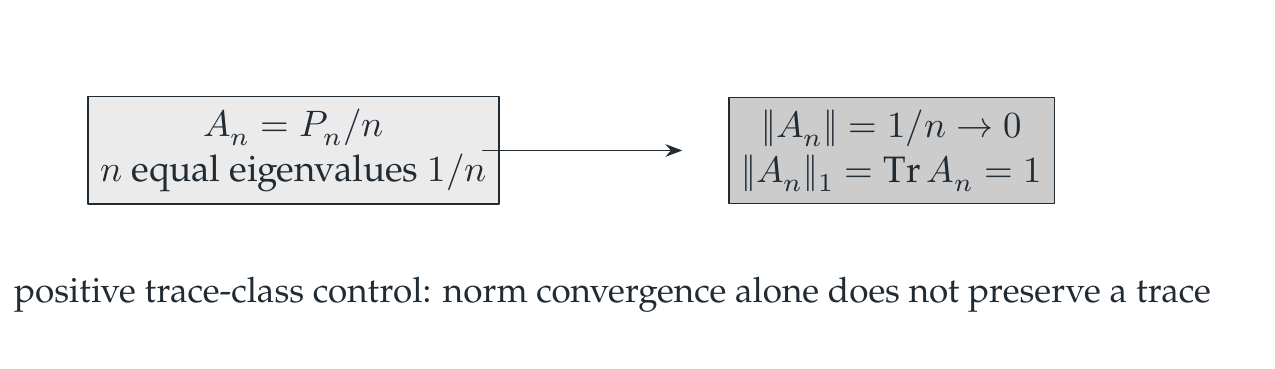
The left box defines the finite-rank operators and their repeated eigenvalues. The right box contrasts their operator norm with their trace norm and trace. The bottom note records the limitation of norm convergence for this quantity.
Drawing labels and data 3 labels
Read the original labels as selectable text. Tables preserve grid relationships; other short labels are grouped compactly.
\(A_n=P_n/n\)
\(n\) equal eigenvalues \(1/n\)
\(\|A_n\|=1/n\to0\)
\(\|A_n\|_1=\operatorname{Tr}A_n=1\)
positive trace-class control: norm convergence alone does not preserve a trace
Operator norm does not preserve trace in growing rank
On \(\ell^2\), let \(P_n\) select the first \(n\) coordinates and set \(A_n=P_n/n\). Then \({\left\lVert A_n\right\rVert}=1/n\to0\) while \({\operatorname{Tr}} A_n=1\) for every \(n\). These positive trace-class operators show why the choice of topology matters. Their zero limit is not the heat operator of a finite Hamiltonian.
For transfers on two states \(T_n={\operatorname{diag}}(1,q_n)=e^{-H_n}\), with \(H_n={\operatorname{diag}}(0,-\log q_n)\) at unit time, the error in trace norm is \(2^{-(n+2)}\) and the heat traces converge to \(3/2\). The criterion for convergence of spectral dimension additionally assumes convergence of the first heat moments in trace norm and a nonzero limiting heat trace. Convergence of the heat trace alone does not determine that quotient.
The retained evidence and the remaining open targets
The extension includes retained exact checks over specified finite ranges in \({\mathbb Q}({\mathrm i})\) using Fraction from Python's standard library. The original appendix's record of 180 checks, including symbolic derivatives, is also retained. Both records come from earlier executions. This prose revision adds no symbolic or Lean kernel run. All model and vector sources remain supplied.
The saved v0.6.0 ledger lists 19 finite items with their recorded hypotheses. Its five original targets for continuum and physical reconstruction remain open. The strengthened edition supplies analytic proofs and criteria for bounded limits. These results and examples do not establish the unresolved physical existence claims.
Read this as
Use pointwise convergence for finite positivity tests, operator norm for bounded dynamics and constraints, and trace norm for heat traces. Every conclusion keeps its own hypotheses and evidence scope.