
Retain one coordinate in \(H={\begin{pmatrix}0&1\\1&2\end{pmatrix}}\), so \(A=0\), \(B=1\), and \(D=2\). In its elimination domain, \(\Sigma(z)=1/(z-2)\). At \(z=3+{\mathrm i}\),
The sign in the upper half plane comes from self-adjoint hidden data. It is not an entrywise sign condition on an arbitrary effective matrix.
Reading the drawing
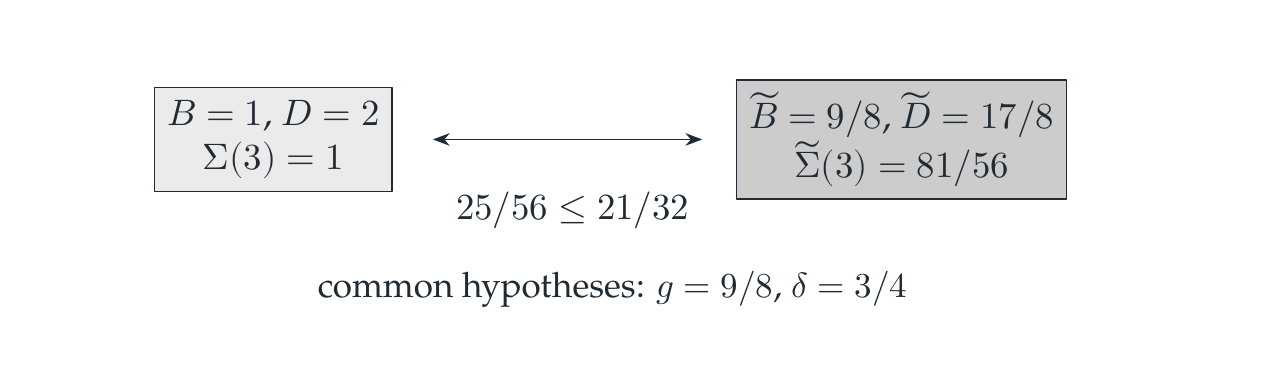
The boxes list the original and perturbed coupling data and self-energies. The comparison between them shows the displayed stability estimate, with its common hypotheses written below.
Drawing labels and data 4 labels
Read the original labels as selectable text. Tables preserve grid relationships; other short labels are grouped compactly.
\(B=1\), \(D=2\)
\(\Sigma(3)=1\)
\(\widetilde B=9/8\), \(\widetilde D=17/8\)
\(\widetilde\Sigma(3)=81/56\)
- \(25/56\leq21/32\)
- common hypotheses: \(g=9/8\), \(\delta=3/4\)
A stability estimate with a common spectral gap
Compare \((B,D)=(1,2)\) with \((\widetilde B,\widetilde D)=(9/8,17/8)\) at \(z=3\). Both hidden spectral distances are at least \(\delta=3/4\), and both couplings are bounded by \(g=9/8\). Then
The theorem bounds the difference using a common spectral gap. Applying the bound uniformly to a refinement family requires uniform spectral separation and control of the couplings.
A series near zero energy and its exact remainder
At \(z=1/2\), \(|z|\,|D^{-1}|=1/4<1\), so
After the first four terms, the exact remainder has magnitude \(1/384\). The geometric series controls the infinite tail. The retained check verifies that remainder, the complex sign identity, and the identities for the projected resolvent and bare truncation at four specified real spectral parameters.
At \(z=2\) the hidden inverse fails. At an eigenvalue of the full Hamiltonian, the retained Feshbach inverse fails. Neither point belongs to the resolvent identity's domain. Analytic continuation of a scalar expression does not erase its theorem hypotheses.
Read this as
A uniform effective response requires a uniform gap and coupling bound. Exact small examples show how those hypotheses enter each estimate.