
On \({\mathcal H}={\mathbb C}^2\), put \(P_0={\operatorname{diag}}(1,0)\), \(P_1=I-P_0\), and
The exact Gram matrices give
Consequently the unitary polar factor is \(S(S^*S)^{-1/2}=R\), and \(Q_aR=RP_a\) for both complete packets.
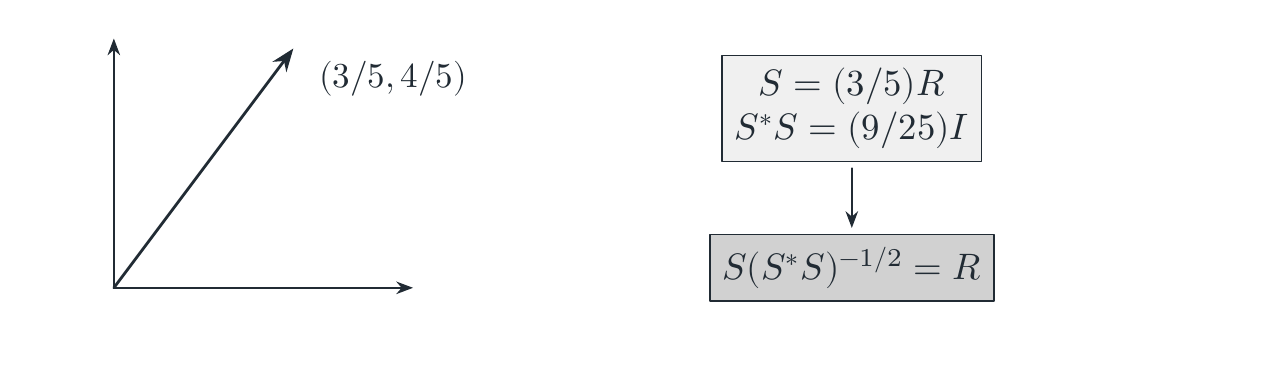
Reading the drawing
The arrow at left marks the displayed unit direction. The boxes and connecting arrow on the right show the scaled map, its Gram product, and the normalized polar factor. The plate discusses where this local chart can fail.
Drawing labels and data 3 labels
Read the original labels as selectable text. Tables preserve grid relationships; other short labels are grouped compactly.
- \((3/5,4/5)\)
\(S=(3/5)R\)
\(S^*S=(9/25)I\)
- \(S(S^*S)^{-1/2}=R\)
The norm condition selects a chart
If the target rank-one packet is orthogonal to the initial one, the two labels are exchanged and \(S=0\). Its polar inverse square root is undefined. This is a failure of this direct local construction, although a unitary carrying one packet system to the other still exists. The strict norm assumption is sufficient, not a global existence criterion for all packet rotations.
Short steps can be composed before reaching a distant endpoint. For example, the rational step \(R_1={\begin{pmatrix}4/5&-3/5\\3/5&4/5\end{pmatrix}}\) obeys
The multiplication is exact and each step has a valid local overlap. The convergence theorem has a separate analytic contract: a twice continuously differentiable complete projector path on a compact time interval, sufficiently fine partitions, and a constant depending on the path in an \(O(|\pi|)\) estimate in operator norm.
Evidence boundary
The retained run checks the Gram identities, polar factor, intertwining, and product of two rational steps. It also checks that the overlap has rank zero when the endpoint packets are orthogonal. It does not certify the analytic convergence theorem by sampling a path.
Read this as
A local polar chart can fail while the subspaces remain regular. Use the stated chart hypothesis and the separate convergence theorem when composing small rotations.