
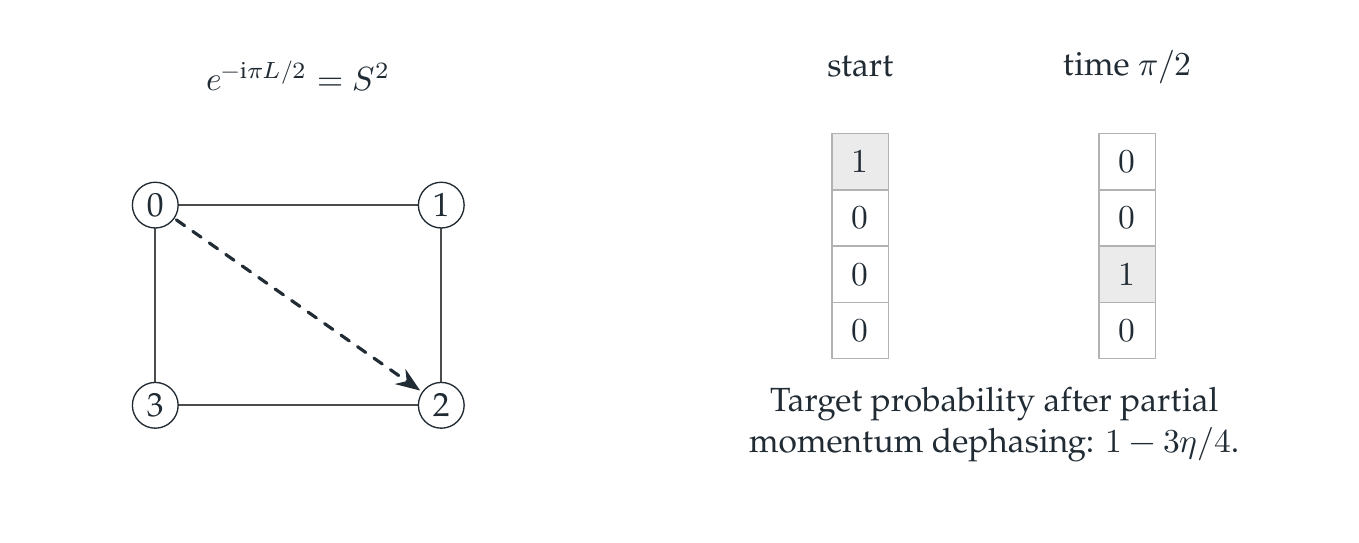
Return to the shift on four sites \(S\) and Laplacian \(L=2I-S-S^*\). The same character projectors have energies \((0,2,4,2)\). At time \(t=\pi/2\), their evolution phases are \((1,-1,1,-1)\), exactly the character eigenvalues of \(S^2\). Hence
Reading the drawing
The left graph marks the cycle and opposite-site transfer. The two columns on the right give the initial and final state amplitudes in address order. The bottom note records the displayed reduction under partial momentum dephasing.
Drawing labels and data 16 labels
Read the original labels as selectable text. Tables preserve grid relationships; other short labels are grouped compactly.
- 0
- 1
- 2
- 3
- \(e^{-{\mathrm i}\pi L/2}=S^2\)
- start
- \(1\)
- \(0\)
- \(0\)
- \(0\)
- time \(\pi/2\)
- \(0\)
- \(0\)
- \(1\)
- \(0\)
Target probability after partial
momentum dephasing: \(1-3\eta/4\).
At halfway time \(\pi/4\), the actual amplitude vector is \((-{\mathrm i},1,{\mathrm i},1)^T/2\), giving uniform site probabilities. The subsequent phases recombine those four amplitudes into a single output at the opposite site. Uniform intermediate probabilities do not imply an incoherent intermediate state.
A channel changes the conclusion predictably
Before evolving, mix the seed density matrix with its complete momentum dephasing:
At transfer time, the probability at the opposite site is exactly \(1-3\eta/4\). Complete momentum dephasing reduces it to \(1/4\). This calculation isolates how discarded coherence changes the interference result.
Finally, the shift grammar generates four independent vectors from \({\left|0\right\rangle}\), while the Hamiltonian powers generate only three: its repeated energy links two momentum directions. The same seed can therefore be cyclic for the shift algebra and noncyclic for the Hamiltonian algebra, even though perfect transfer occurs at one time.
Read this as
Perfect transfer is an exact finite interference statement. It neither implies cyclicity for every operator grammar nor survives an unaccounted dephasing operation.