
On a two-dimensional code, consider the overlap compression
For instance, within the code take \(E_a=I\) and \(E_b=A\). This declares an error family, not by itself a normalized noise channel. The optimal scalar compression has
Indeed, for every complex \(c\), the triangle inequality gives
Thus the larger of the two distances is at least \(1/10\), while both distances equal \(1/10\) at \(c=1\).
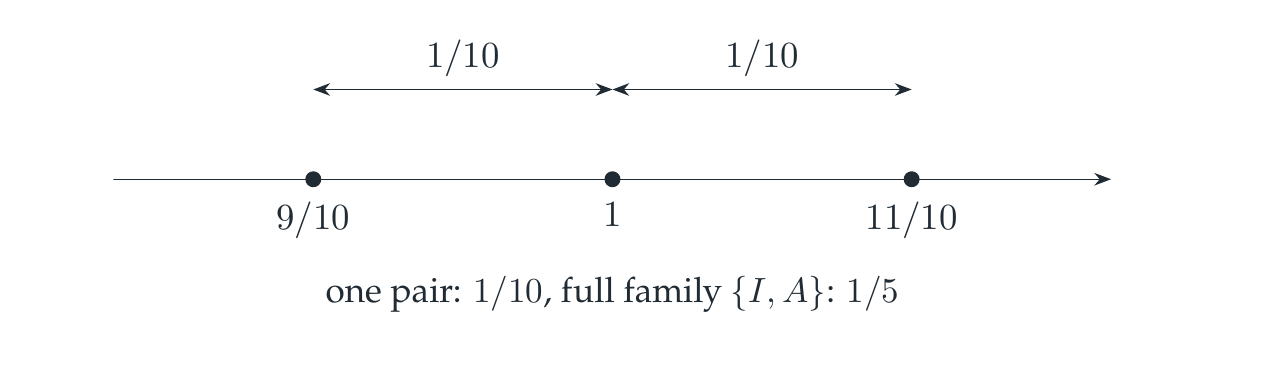
Reading the drawing
The marked scalar lies between two spectral endpoints, with equal distances shown above the line. The note below distinguishes the defect for one pair from the defect for the stated full operator family.
Drawing labels and data 6 labels
Read the original labels as selectable text. Tables preserve grid relationships; other short labels are grouped compactly.
- \(9/10\)
- \(1\)
- \(11/10\)
- \(1/10\)
- \(1/10\)
- one pair: \(1/10\), full family \(\{I,A\}\): \(1/5\)
What one pair contributes to the family defect
For unit code vectors \(\psi,\phi\), this pair therefore satisfies
The bound is attained on either coordinate vector. For the whole declared family \(\{I,A\}\), the \(A^*A\) compression also enters the maximum: its diagonal entries are \(121/100,81/100\), giving pair defect \(1/5\). Hence the full family value is \(\varepsilon_{\rm KL}=1/5\), not \(1/10\).
This distinction prevents a tempting shortcut from one favorable overlap to an approximate correction claim. The quantity measures how close all overlap operators are to scalar action on the code. A recovery fidelity bound requires a declared normalized channel, a metric, and a separate continuity result.
What is checked exactly
For \(\varepsilon\in\{0,1/10,1/4,1\}\) the script checks \((A-I)^*(A-I)=\varepsilon^2I\) for \(A={\operatorname{diag}}(1+\varepsilon,1-\varepsilon)\) and several rational scalar controls. The triangle argument proves the lower bound for every complex scalar. Checking a finite list of candidates would not establish that conclusion. The family maximum above is also recorded separately.
Read this as
An overlap norm has a useful operational interpretation. Evaluate every error pair, then keep that statement separate from an unproved recovery fidelity estimate.