
On \({\mathcal H}={\mathbb C}^3\), take the strictly positive contraction
At unit Euclidean time, \(T=e^{-H}\). The self-adjoint logarithm is unique because the logarithm acts on positive spectral values. At integer time \(n\geq0\),
The gap \(\Delta=\log2\) determines the rate \(e^{-n\Delta}\) exactly in this example.
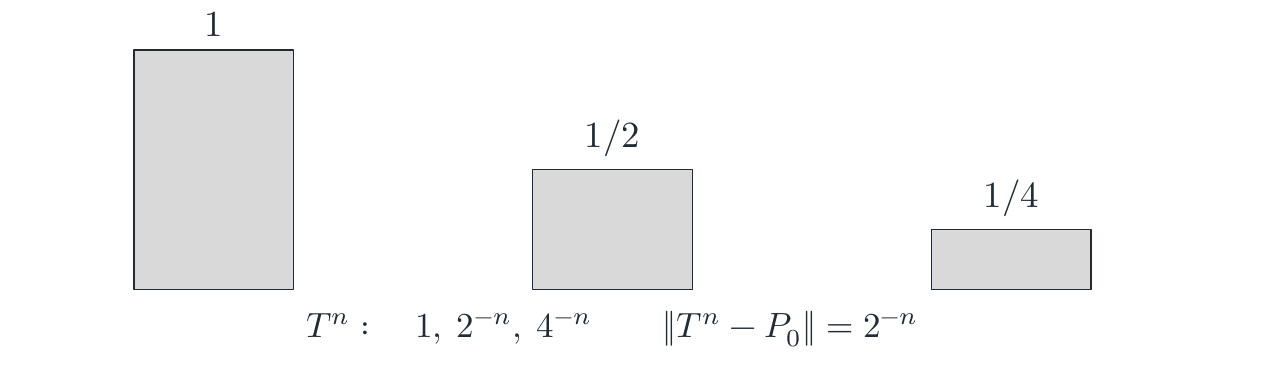
Reading the drawing
The bars show the three diagonal transfer values at unit time. The annotation below gives their integer-time powers and the error from the ground projector. The unit eigenvalue persists while the other two decay.
Drawing labels and data 4 labels
Read the original labels as selectable text. Tables preserve grid relationships; other short labels are grouped compactly.
- \(1\)
- \(1/2\)
- \(1/4\)
Strict positivity is an essential finite hypothesis
For \(T'={\operatorname{diag}}(1,0)\), the operator is positive semidefinite, but there is no finite self-adjoint \(H'\) on all of \({\mathbb C}^2\) with \(T'=e^{-H'}\): every finite eigenvalue of \(H'\) exponentiates to a strictly positive value. One may restrict to the positive support, but that changes the space on which the logarithm is defined.
For a family with nontrivial excited spectra, a uniform exponential rate needs a common positive lower bound on the gap. Ground multiplicity does not cause a problem: \(P_0\) selects the entire eigenspace at the minimum energy. For a Hamiltonian whose minimum is \(E_0\ne0\), the normalized transfer is \(e^{-t(H-E_0I)}\) before taking the limit.
Positivity is retained at several Euclidean times
For arbitrary vectors \(u_j\) and nonnegative integer times \(n_j\), the reflected kernel obeys
This is a finite Gram factorization. The retained run checks the integer semigroup and diagonal ground error for \(n=0,\ldots,12\), and rejects a logarithm on the full space for the singular control. The written spectral argument justifies the logarithms and extends the functional calculus statement to all times.
Read this as
A positive definite transfer can be logarithmically reconstructed. Ground convergence needs a declared normalization and gap, while continuum reconstruction still needs its own structure.