
On four sites, let \(S{\left|k\right\rangle}={\left|k+1\bmod4\right\rangle}\) and let \(\omega={\mathrm i}\). The character projectors are the exact matrices
All entries belong to the Gaussian rationals. Thus no approximation to a root of unity is needed in this model.
Reading the drawing
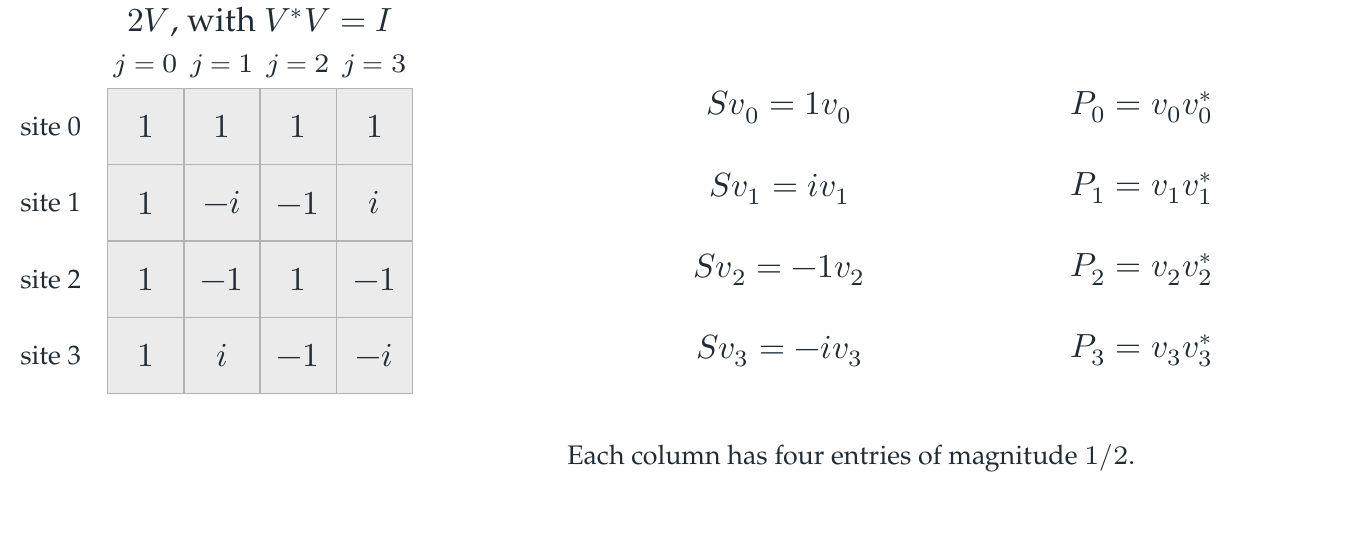
The matrix at left lists four normalized character columns after the displayed scaling. The equations on the right pair each column with its shift eigenvalue and rank-one projector. The note below states the common entry magnitude.
Drawing labels and data 34 labels
Read the original labels as selectable text. Tables preserve grid relationships; other short labels are grouped compactly.
- \(2V\), with \(V^*V=I\)
| Row / column | \(j=0\) | \(j=1\) | \(j=2\) | \(j=3\) |
|---|---|---|---|---|
| site 0 | \(1\) | \(1\) | \(1\) | \(1\) |
| site 1 | \(1\) | \(- i\) | \(-1\) | \(i\) |
| site 2 | \(1\) | \(-1\) | \(1\) | \(-1\) |
| site 3 | \(1\) | \(i\) | \(-1\) | \(- i\) |
- \(S v_0=1v_0\)
- \(P_0=v_0v_0^*\)
- \(S v_1=iv_1\)
- \(P_1=v_1v_1^*\)
- \(S v_2=-1v_2\)
- \(P_2=v_2v_2^*\)
- \(S v_3=- iv_3\)
- \(P_3=v_3v_3^*\)
- Each column has four entries of magnitude \(1/2\).
Reading the columns
Each column \(v_j\) is a normalized wave around the four sites. Advancing the address multiplies it by \({\mathrm i}^j\). The entries show phase differences rather than four different probability distributions: every column has uniform site probability \(1/4\).
Multiplying the actual projectors gives \(P_jP_k=0\) for \(j\ne k\), \(P_j^2=P_j\), and \(\sum_jP_j=I\). In particular, the complete packet tuple \((P_j\psi)_j\) retains the original vector exactly. Recording only the four packet norms is a different operation and can discard phase information between packets.
The same shift on four sites returns on Visual 27, where it diagonalizes the Hamiltonian \(L=2I-S-S^*\), and its four character phases explain perfect transfer between opposite sites. The same fixed projectors serve as coordinates, symmetry sectors, and a complete interference ledger.
Read this as
A character projector retains a complex subspace component. Its norm summarizes the size of that component while leaving its phase and direction unspecified.