
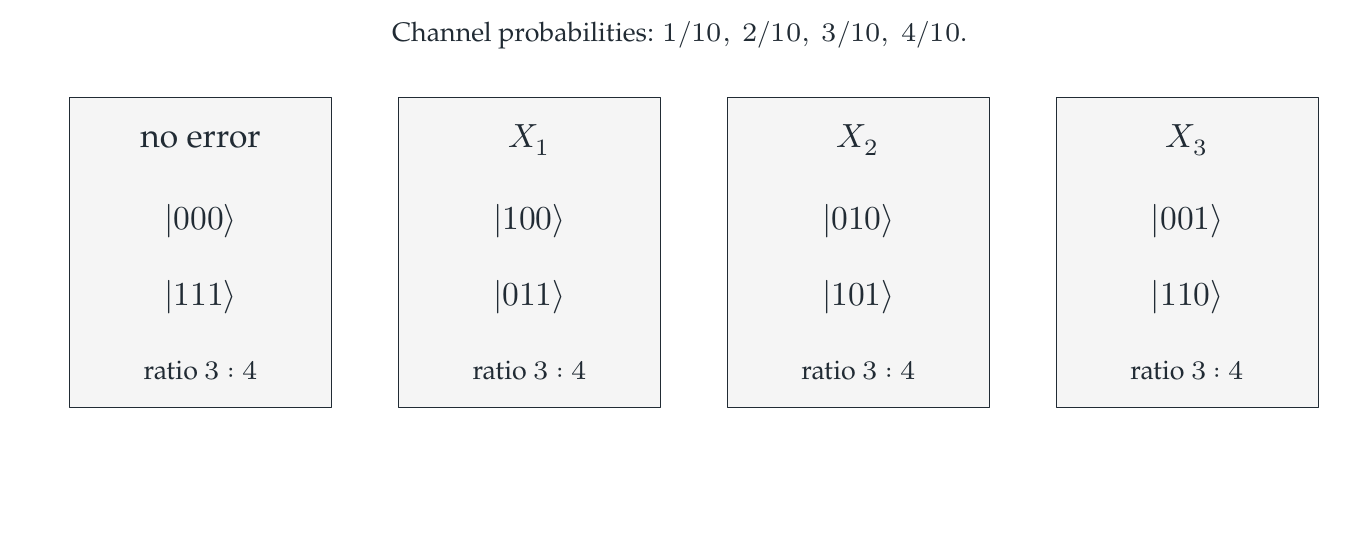
Encode a qubit by \({\left|0_L\right\rangle}={\left|000\right\rangle}\) and \({\left|1_L\right\rangle}={\left|111\right\rangle}\). Let \(P\) project onto this code and take errors \(E_a\in\{I,X_1,X_2,X_3\}\). Their images are four orthogonal rank-two packets \(Q_a=E_aPE_a^*\) that sum to the full identity.
Reading the drawing
The boxes represent no error and the three single-bit flips. Each contains the corresponding pair of addresses and the same amplitude ratio. The channel branch probabilities are listed above the boxes.
Drawing labels and data 17 labels
Read the original labels as selectable text. Tables preserve grid relationships; other short labels are grouped compactly.
- no error
- \({\left|000\right\rangle}\)
- \({\left|111\right\rangle}\)
- ratio \(3:4\)
- \(X_1\)
- \({\left|100\right\rangle}\)
- \({\left|011\right\rangle}\)
- ratio \(3:4\)
- \(X_2\)
- \({\left|010\right\rangle}\)
- \({\left|101\right\rangle}\)
- ratio \(3:4\)
- \(X_3\)
- \({\left|001\right\rangle}\)
- \({\left|110\right\rangle}\)
- ratio \(3:4\)
Channel probabilities: \(1/10,\ 2/10,\ 3/10,\ 4/10\).
Use the logical state \(\psi=(3{\left|0_L\right\rangle}+4{\left|1_L\right\rangle})/5\) and channel probabilities \(w=(1,2,3,4)/10\). The noisy state is \(\sum_aw_aE_a\psi\psi^*E_a^*\). A syndrome measurement returns label \(a\) with probability \(w_a\), independent of the logical amplitudes.
The recovery is an actual channel
The operators \(R_a=E_a^*Q_a\) satisfy \(\sum_aR_a^*R_a=I\). Applying the recovery \(\mathcal R(X)=\sum_aR_aXR_a^*\) to the noisy state gives exactly \(\psi\psi^*\). The off-diagonal logical coherence \(12/25\) is recovered as well as the populations \(9/25\) and \(16/25\).
The Knill–Laflamme compressions are \(PE_a^*E_bP=\delta_{ab}P\). Their scalar form says that the error labels do not resolve the encoded vector. The exact checks evaluate all sixteen compressions, all sixteen syndrome products, the four probabilities, the recovery normalization, and the full recovered matrix.
This code corrects the specified flips of individual bits. That result does not cover arbitrary errors on three qubits or arbitrary errors on a single qubit. The next example exhibits an error outside its protected family.
Read this as
A syndrome identifies an error subspace while leaving a two-dimensional logical subspace intact. Measuring the two logical basis states separately would destroy the information the recovery must preserve.