
For \(H=I-X\), the two eigenvalues are zero and two. Its Euclidean transfer is
For \(\tau\ge0\), the eigenvalues \(1,q\) lie in \((0,1]\), and multiplying two such matrices replaces \(q,r\) by \(qr\). This is the semigroup law in spectral coordinates.
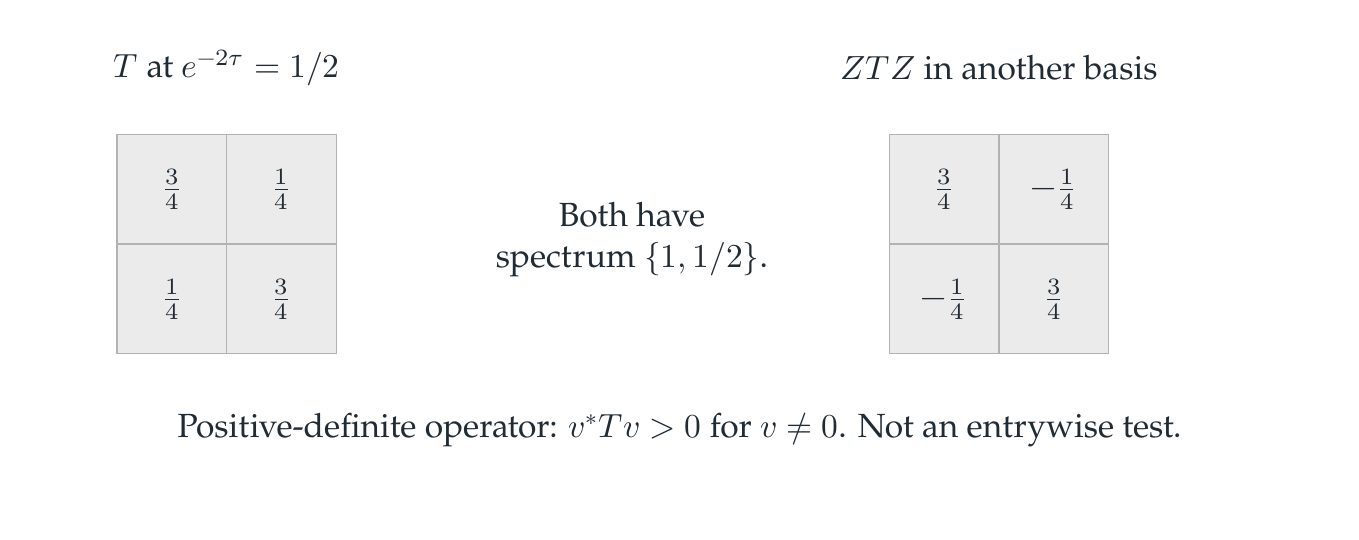
Reading the drawing
The left matrix is the transfer in one basis and the right matrix is its conjugate in another. Their common spectrum is written between them. The note below uses a quadratic-form test rather than an entrywise sign test.
Drawing labels and data 12 labels
Read the original labels as selectable text. Tables preserve grid relationships; other short labels are grouped compactly.
- \(T\) at \(e^{-2\tau}=1/2\)
| Row / column | Column 1 | Column 2 |
|---|---|---|
| Row 1 | \(\frac{3}{4}\) | \(\frac{1}{4}\) |
| Row 2 | \(\frac{1}{4}\) | \(\frac{3}{4}\) |
- \(ZTZ\) in another basis
| Row / column | Column 1 | Column 2 |
|---|---|---|
| Row 1 | \(\frac{3}{4}\) | \(- \frac{1}{4}\) |
| Row 2 | \(- \frac{1}{4}\) | \(\frac{3}{4}\) |
Both have
spectrum \(\{1,1/2\}\).
Positive-definite operator: \(v^*Tv>0\) for \(v\ne0\). Not an entrywise test.
At \(q=1/2\), the displayed \(T\) happens also to have nonnegative entries and column sums one. Conjugate by the unitary \(Z\). The spectrum and positivity of the quadratic form are preserved, but both off-diagonal entries become \(-1/4\). Thus positivity as an operator is not entrywise positivity and does not by itself give a Markov interpretation.
A useful finite positive kernel
For this nonnegative \(H\), vectors \(u_a\) and times \(t_a\ge0\) satisfy
The factorization makes positivity transparent. It remains a finite operator identity. A continuum reconstruction theorem requires a compatible field structure, limits, positivity hypotheses, and the other assumptions of the chosen reconstruction framework. Each of these assumptions requires its own justification beyond the two positive eigenvalues.
The exact check verifies the matrix semigroup law as a polynomial identity in \(q,r\) and verifies the unchanged spectrum after conjugation. It rejects entrywise nonnegativity for the conjugated matrix.
Read this as
Euclidean positivity refers to quadratic forms and spectral values. A stochastic interpretation or a continuum physical reconstruction needs additional structure.