
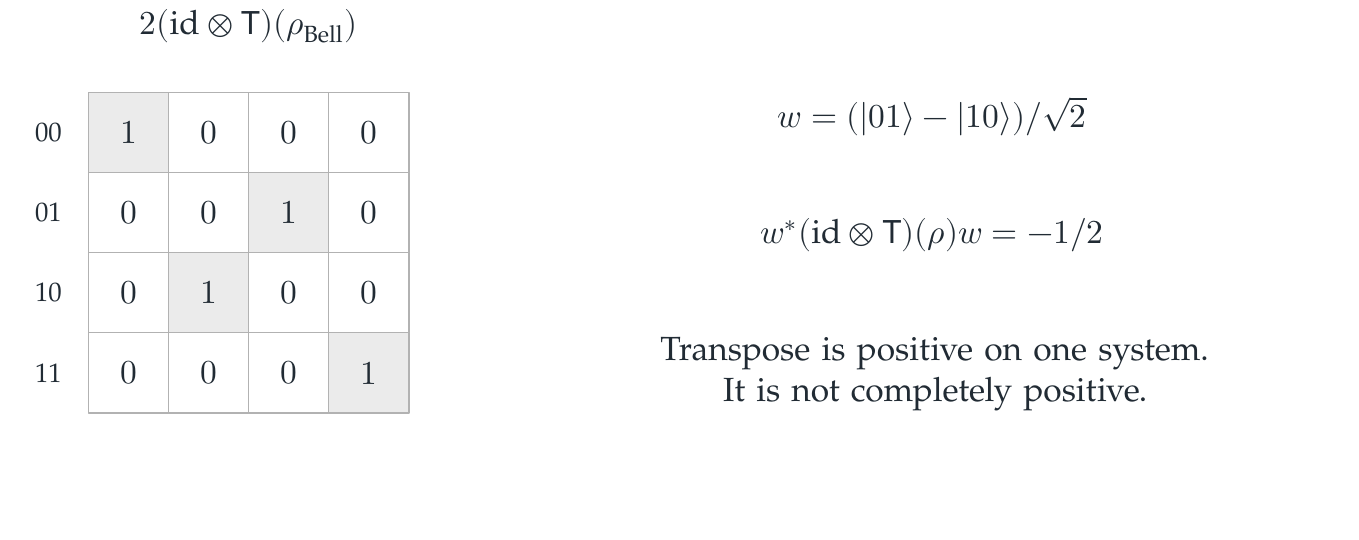
Ordinary transpose \(\mathsf T\) sends a positive matrix on one system to another positive matrix and preserves its trace. Those properties are insufficient for a quantum channel on a subsystem of an entangled state. The test must include \({\mathrm{id}}\otimes\mathsf T\) on the larger system.
Reading the drawing
The left matrix is the displayed scaled partial-transpose output. The right side supplies a vector and its negative quadratic form. The accompanying note distinguishes positivity on one system from complete positivity.
Drawing labels and data 24 labels
Read the original labels as selectable text. Tables preserve grid relationships; other short labels are grouped compactly.
| Row / column | Column 1 | Column 2 | Column 3 | Column 4 |
|---|---|---|---|---|
| 00 | \(1\) | \(0\) | \(0\) | \(0\) |
| 01 | \(0\) | \(0\) | \(1\) | \(0\) |
| 10 | \(0\) | \(1\) | \(0\) | \(0\) |
| 11 | \(0\) | \(0\) | \(0\) | \(1\) |
- \(w=({\left|01\right\rangle}-{\left|10\right\rangle})/\sqrt2\)
\(w^*({\mathrm{id}}\otimes{\mathsf T})(\rho)w=-1/2\)
Transpose is positive on one system.
It is not completely positive.
Apply this extended map to the Bell density matrix. The result is
Its middle block has one negative eigenvalue. More concretely, the normalized vector \(w=({\left|01\right\rangle}-{\left|10\right\rangle})/\sqrt2\) satisfies
This exact negative value of the quadratic form certifies failure of positivity on the composite system. No numerical eigenvalue tolerance is needed.
Why the Kraus form avoids this problem
For every auxiliary dimension and positive \(X\), each term \((I\otimes K_a)X(I\otimes K_a)^*\) is positive. Their sum is positive as well. This argument explains the word completely. The conclusion holds for every auxiliary dimension, which a test of one input density matrix on the original system cannot establish.
The transpose counterexample is an explanatory finite calculation, not a new addition to the formal theorem count. It makes visible the hypothesis that the manuscript's Kraus result already supplies. The exact check constructs the partial transpose with the stated tensor indexing and evaluates its negative witness directly.
Read this as
A map can look harmless on an isolated system and fail on an entangled extension. Complete positivity retains compatibility with every auxiliary system.