
Apply \(Z_1=Z\otimes I\otimes I\) to the same repetition code. It sends \({\left|000\right\rangle}\) to itself and \({\left|111\right\rangle}\) to its negative. Both states remain inside the original code, so the previous syndrome partition reports no bit flip.
The populations are unchanged, but the relative phase is not.
Reading the drawing
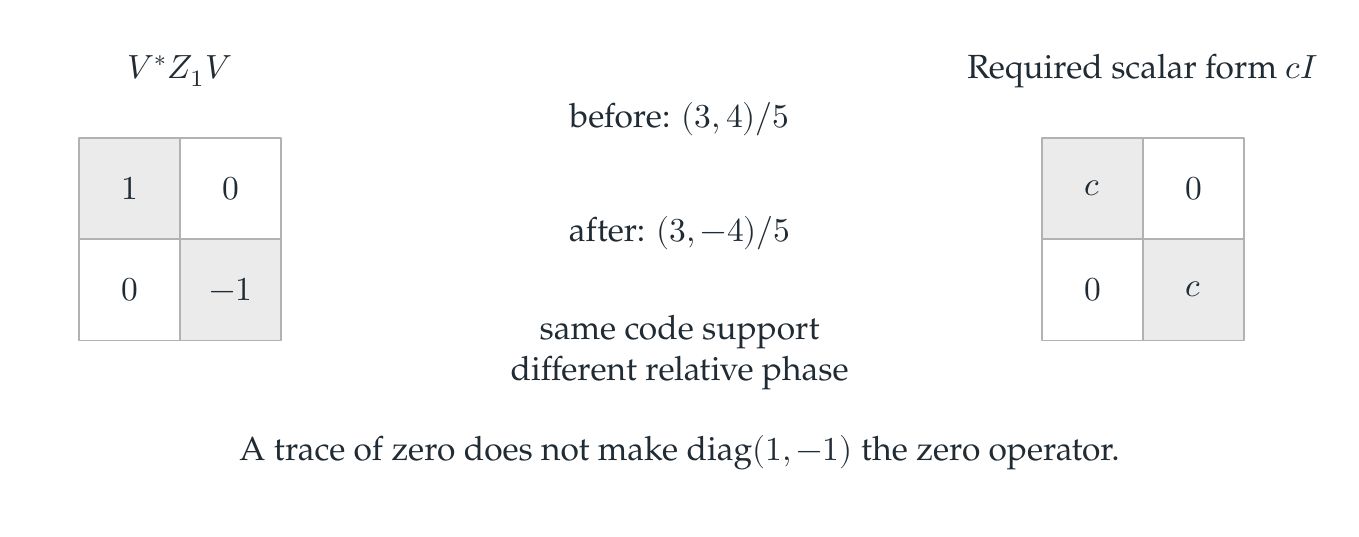
The left matrix changes the relative sign of the displayed encoded amplitudes while preserving their code support. The right matrix shows the scalar form required by the criterion. The bottom note distinguishes zero trace from the zero operator.
Drawing labels and data 14 labels
Read the original labels as selectable text. Tables preserve grid relationships; other short labels are grouped compactly.
- \(V^*Z_1V\)
| Row / column | Column 1 | Column 2 |
|---|---|---|
| Row 1 | \(1\) | \(0\) |
| Row 2 | \(0\) | \(-1\) |
- before: \((3,4)/5\)
- after: \((3,-4)/5\)
same code support
different relative phase
- Required scalar form \(cI\)
| Row / column | Column 1 | Column 2 |
|---|---|---|
| Row 1 | \(c\) | \(0\) |
| Row 2 | \(0\) | \(c\) |
A trace of zero does not make \({\operatorname{diag}}(1,-1)\) the zero operator.
Let \(V\) be the code isometry with columns \({\left|000\right\rangle},{\left|111\right\rangle}\). For the proposed error family \(\{I,Z_1\}\), its off-diagonal error compression is
This matrix is not \(cI\) for any scalar \(c\). Thus the Knill–Laflamme condition fails for that family. Its trace is zero even though its action on the code is nonzero. A trace test alone would miss the obstruction.
Known correction versus family recovery
If it is known with certainty that \(Z_1\) occurred, applying \(Z_1\) again reverses it. The failed criterion concerns a single recovery valid for every unknown error in the declared family, not invertibility of each error considered separately. This distinction prevents a misleading conclusion that no phase error can ever be undone.
The finite calculation checks the actual compressed matrix and rejects its equality to zero. The scalar obstruction is then transparent from the two unequal diagonal entries.
Read this as
Correction must preserve all logical superpositions for the declared error family. Staying in the code and preserving basis probabilities are not sufficient.