
Take \(H={\begin{pmatrix}0&1\\1&2\end{pmatrix}}\) and retain its first coordinate. The eliminated block is \(H_{QQ}=2\). Whenever \(z-2\) and the full \(zI-H\) are invertible,
This is the corrected hypothesis set recorded in the formal release.
Reading the drawing
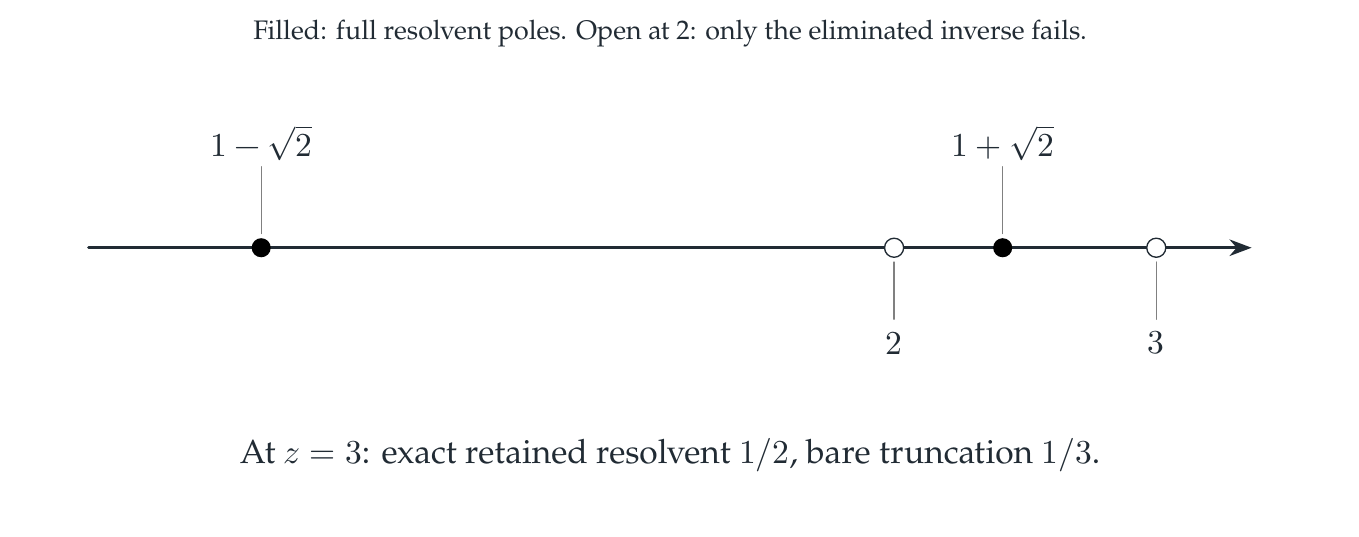
The filled points mark poles of the full resolvent. Open points mark the displayed hidden-sector inverses that fail. The bottom comparison evaluates the exact retained resolvent and the bare truncation at the same regular spectral point.
Drawing labels and data 6 labels
Read the original labels as selectable text. Tables preserve grid relationships; other short labels are grouped compactly.
- \(1-\sqrt2\)
- \(1+\sqrt2\)
- \(2\)
- \(3\)
Filled: full resolvent poles. Open at 2: only the eliminated inverse fails.
At \(z=3\): exact retained resolvent \(1/2\), bare truncation \(1/3\).
At \(z=3\), the exact retained resolvent is \(1/2\). Bare truncation uses only \(H_{PP}=0\) and gives \(1/3\), an error of \(1/6\). The omitted coupling has changed the response even though the retained diagonal entry did not change.
A pole can belong to the elimination chart
At \(z=2\), the eliminated inverse does not exist, so the displayed Schur formula cannot be applied there as written. Nevertheless, the full resolvent exists and its retained entry is zero. The rational expression has a continuation to this value. By contrast, \(1\pm\sqrt2\) are poles of the full resolvent.
Invertibility of the full matrix is an independent requirement. At \(z=0\), \(H={\operatorname{diag}}(0,-1)\) has an invertible eliminated block in \(zI-H\), but the full matrix is singular. The original prose omitted this condition. The preserved amendments restore it. This appendix uses the corrected form throughout.
Read this as
An exact elimination formula has a spectral domain. Check both inverses before evaluating it, and distinguish poles of an intermediate inverse from poles of the full physical resolvent.