
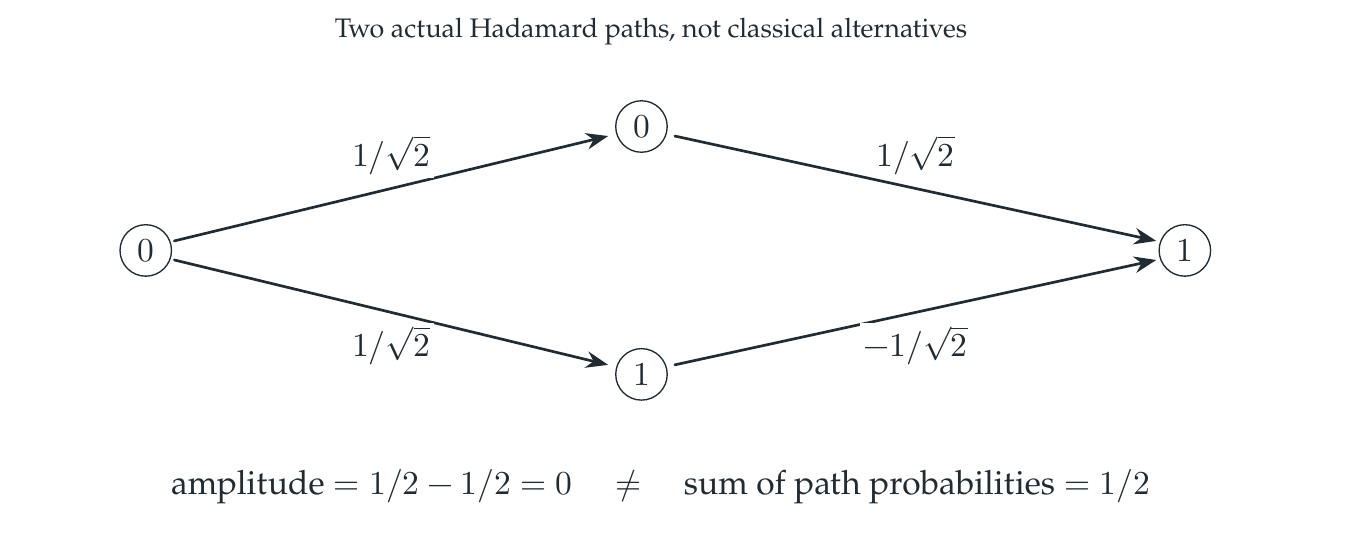
Two consecutive Hadamard gates multiply to the identity. Starting from \({\left|0\right\rangle}\), there are two resolved paths to output \({\left|1\right\rangle}\). Their signed products are
Their sum is zero. Squaring each separately gives a different answer.
Reading the drawing
The diagram branches through the two intermediate addresses and recombines at the selected output. One second-stage amplitude has a minus sign. The comparison below separates the sum of amplitudes from a sum of path probabilities.
Drawing labels and data 10 labels
Read the original labels as selectable text. Tables preserve grid relationships; other short labels are grouped compactly.
- \(0\)
- \(0\)
- \(1\)
- \(1\)
- \(1/\sqrt2\)
- \(1/\sqrt2\)
- \(1/\sqrt2\)
- \(-1/\sqrt2\)
Two actual Hadamard paths, not classical alternatives
Where the missing term goes
For path amplitudes \(a,b\), the outcome probability is \(|a+b|^2=|a|^2+|b|^2+2\Re(a\bar b)\). Here the last term is \(-1/2\), canceling the first two terms. The path picture retains this information only if its edges carry complex amplitudes rather than unsigned reachability or probabilities.
The packetwise unitarity identity is likewise an operator identity, including the off-diagonal cancellations:
It cannot be replaced by the assertion that every path individually has unit norm. The exact checks verify all four choices of \(a,c\) for the two rank-one packets, as well as the two path products leading to the opposite output.
A measurement at the intermediate stage would remove the cross term. In that modified experiment the two alternatives really would contribute total probability \(1/2\) to output one. Adding the two path probabilities would therefore describe the experiment with an intermediate measurement.
Read this as
Insert projectors algebraically to resolve paths, then add amplitudes. Add probabilities only when the physical setup has actually made the alternatives incoherent.