
For the circle symbol, the continuum value is \(k^2\) and the grid value is
For a fixed low mode, the paper bounds the error by \(0\le k^2-\lambda_{k,h}\le k^4h^2/12\). The spacing condition matters because the displayed expression divides by \(h^2\).
Reading the drawing
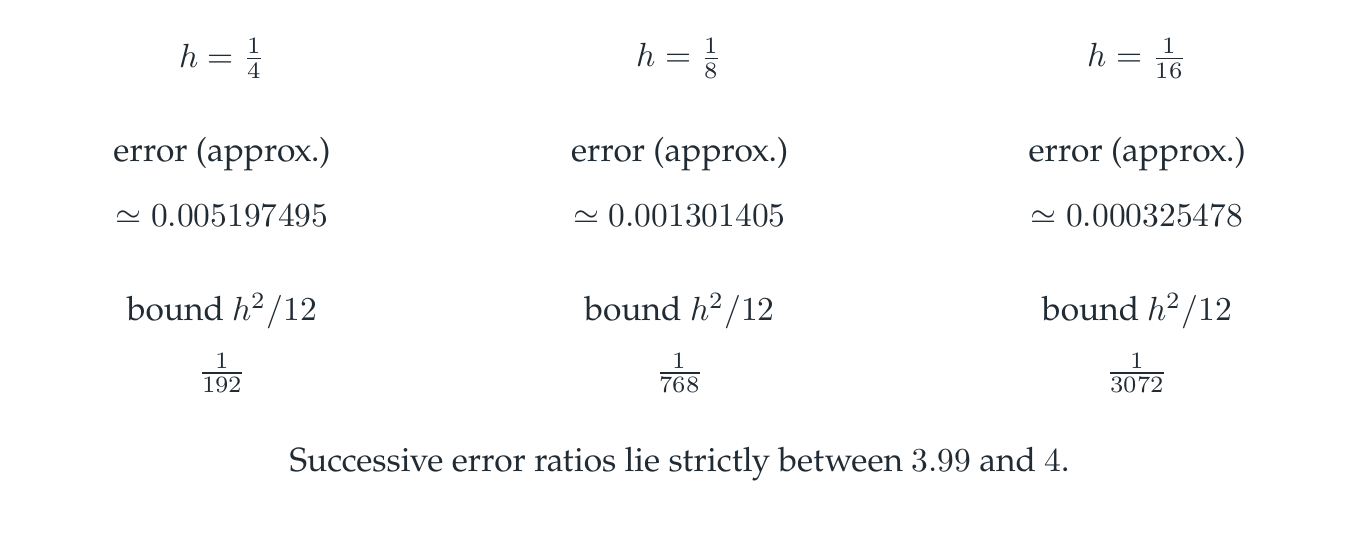
Each column gives a spacing, its displayed approximate error, and an exact bound. The bottom note compares successive error ratios. The retained plate explains the exact enclosure behind the displayed approximations.
Drawing labels and data 16 labels
Read the original labels as selectable text. Tables preserve grid relationships; other short labels are grouped compactly.
\(h=\frac{1}{4}\)
- error (approx.)
- \(\simeq 0.005197495\)
- bound \(h^2/12\)
\(\frac{1}{192}\)
\(h=\frac{1}{8}\)
- error (approx.)
- \(\simeq 0.001301405\)
- bound \(h^2/12\)
\(\frac{1}{768}\)
\(h=\frac{1}{16}\)
- error (approx.)
- \(\simeq 0.000325478\)
- bound \(h^2/12\)
\(\frac{1}{3072}\)
Successive error ratios lie strictly between \(3.99\) and \(4\).
What is certified in the displayed table?
Take \(k=1\) and \(h=1/4,1/8,1/16\). For \(x=h/2\in[0,1]\), alternating Taylor sums give rational lower and upper bounds for \(\sin x\). Squaring these positive endpoints and multiplying by \(4/h^2\) yields exact rational enclosures for each error. The displayed decimals only locate those much narrower rational intervals.
Each interval lies strictly inside \((0,h^2/12)\). Dividing successive interval endpoints proves that both error ratios are between \(3.99\) and \(4\). The check verifies these inequalities by rational arithmetic, without relying on approximate sine values or a fitted logarithmic slope.
Why the mode regime matters
If instead \(k=\pi/h\) moves with the grid, the ratio \(\lambda_{k,h}/k^2=4/\pi^2\) stays constant, not one. The bound's factor \(k^4\) warns that it is not uniform in arbitrary moving high modes. The displayed rational test evaluates the analytic symbol. It does not assert that every chosen spacing defines an integer periodic grid.
Read this as
Second-order convergence is a quantified statement with a specified mode regime. Keep that regime fixed when reading an error curve or comparing refinements.