
Use retained space \({\mathbb C}\) and hidden space \({\mathbb C}^2\), with \(A=0\), \(B=(3/5,4/5)\), and \(D={\operatorname{diag}}(1,2)\). The full Hamiltonian is \({\begin{pmatrix}0&3/5&4/5\\3/5&1&0\\4/5&0&2\end{pmatrix}}\). Its memory kernel is
Each oscillatory coefficient is positive although \(K(t)\) need not be real or pointwise nonnegative. At \(t=\pi/2\), it equals \(-16/25-9{\mathrm i}/25\).
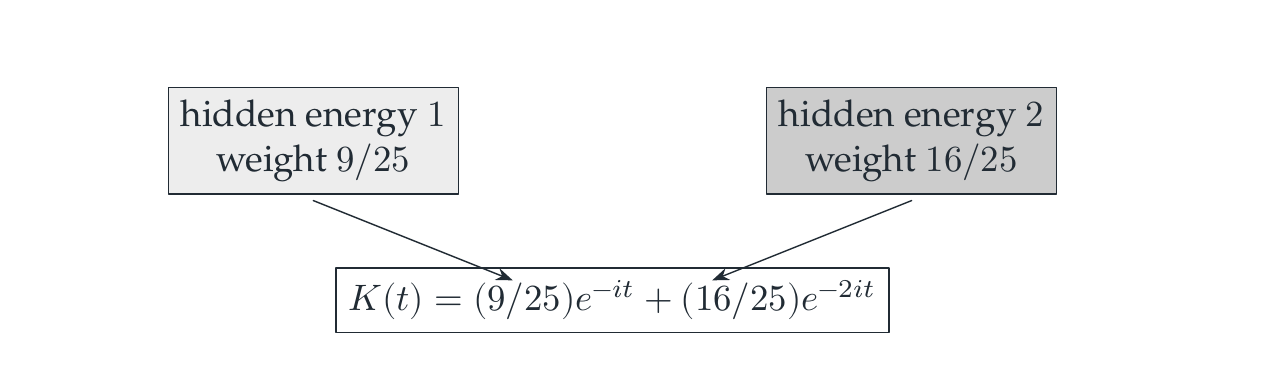
Reading the drawing
The two upper boxes give hidden energies and weights. Arrows combine them into the kernel expression below. The plate uses the corresponding Gram factorization to explain positivity.
Drawing labels and data 3 labels
Read the original labels as selectable text. Tables preserve grid relationships; other short labels are grouped compactly.
hidden energy \(1\)
weight \(9/25\)
hidden energy \(2\)
weight \(16/25\)
- \(K(t)=(9/25)e^{-it}+(16/25)e^{-2it}\)
Positive definite means a matrix test at arbitrary times
For retained scalars \(v_j\) and real times \(t_j\), the structural identity is
The exact worked check specializes to \(t=(0,\pi/2,\pi)\) and \(v=(1,2,-1)\). Its phases lie in \({\mathbb Q}({\mathrm i})\), so both sides are computed without evaluating trigonometric functions. This Gram test illustrates the factorization. The written identity proves positivity for all choices of times and vectors.
Why this does not close to a bare local equation
With hidden initial state zero, the full system has \(\ddot x(0)=-(A^2+BB^*)x(0)=-x(0)\). The bare retained equation \({\mathrm i}\dot x=Ax\) would instead give zero acceleration. Therefore exact local closure for every retained initial state fails. More generally, equality of these accelerations forces \(BB^*=0\) and hence \(B=0\).
A nonzero initial hidden vector also supplies the forcing term \(Be^{-{\mathrm i} tD}y(0)\). It is additional data, not part of the convolution kernel. The retained checks cover the displayed kernel values, exact Gram factorization, and acceleration defect. The integral equation follows from the written elimination argument.
Read this as
Memory is positive definite through a Gram factorization, not through pointwise signs. Exact bare local closure requires the coupling to vanish.