
Take \(S=Z={\operatorname{diag}}(1,-1)\) on \({\mathbb C}^2\). Under conjugation \(X\mapsto ZXZ\), diagonal matrices have coherence order zero and off-diagonal matrices have coherence order one modulo two. Its projectors on Hilbert–Schmidt operator space are \({\mathcal L}_0(X)=(X+ZXZ)/2\) and \({\mathcal L}_1(X)=(X-ZXZ)/2\).
Choose amplitude damping with \(K_0={\operatorname{diag}}(1,4/5)\) and \(K_1=(3/5){\left|0\right\rangle}{\left\langle1\right|}\). The channel is trace preserving, population flows from state one to state zero, and each coherence contracts by \(4/5\).
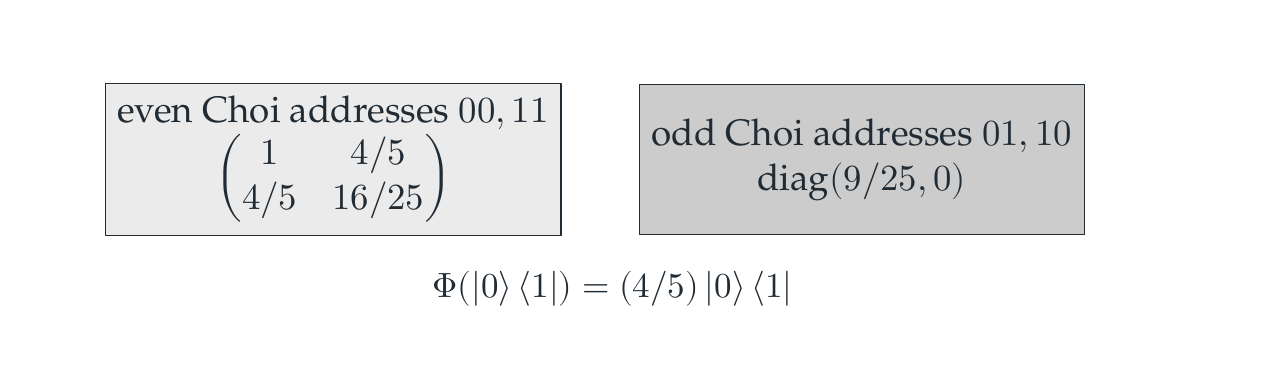
Reading the drawing
The left box contains the block on addresses 00 and 11; the right box contains the block on addresses 01 and 10. The equation below gives the channel action on one coherence entry.
Drawing labels and data 3 labels
Read the original labels as selectable text. Tables preserve grid relationships; other short labels are grouped compactly.
even Choi addresses \(00,11\)
odd Choi addresses \(01,10\)
\(\operatorname{diag}(9/25,0)\)
- \(\Phi({\left|0\right\rangle}{\left\langle1\right|})=(4/5){\left|0\right\rangle}{\left\langle1\right|}\)
With the unnormalized Choi convention \(J=\sum_{a,b}\Phi({\left|a\right\rangle}{\left\langle b\right|})\otimes{\left|a\right\rangle}{\left\langle b\right|}\) and basis \((00,01,10,11)\), the exact matrix is
The \(00,11\) block is positive and has rank one. The other nonzero eigenvalue is \(9/25\). The retained check also verifies that every principal minor is nonnegative.
Symmetry in continuous time has its own hypotheses
For the Lindblad generator with Hamiltonian \(H={\operatorname{diag}}(0,2)\) and jump \(L=(3/5){\left|0\right\rangle}{\left\langle1\right|}\), \(H\) has charge zero and \(L\) has charge one. Each matrix unit stays within its coherence order under the generator. Replacing \(H\) by \(X\) breaks that conclusion: the generator then sends a diagonal matrix to off-diagonal entries.
All four input matrix units are checked exactly for channel covariance, generator order preservation, and zero generator trace. The paper uses the finite exponential series to extend generator invariance to the semigroup. The retained calculation uses no numerical solver for the master equation. Symmetry alone does not close the scalar population equations inside packets of higher rank.
Read this as
Charge is a property of operator space. Covariance preserves its coherent sectors, while complete positivity is checked separately through Kraus or Choi data.