
A quantum calculation becomes easier to follow when its objects remain visible. This appendix follows a state vector, a density matrix, and a retained part of a dynamical system. They may describe the same experiment, but they do not answer the same question.
Reading the drawing
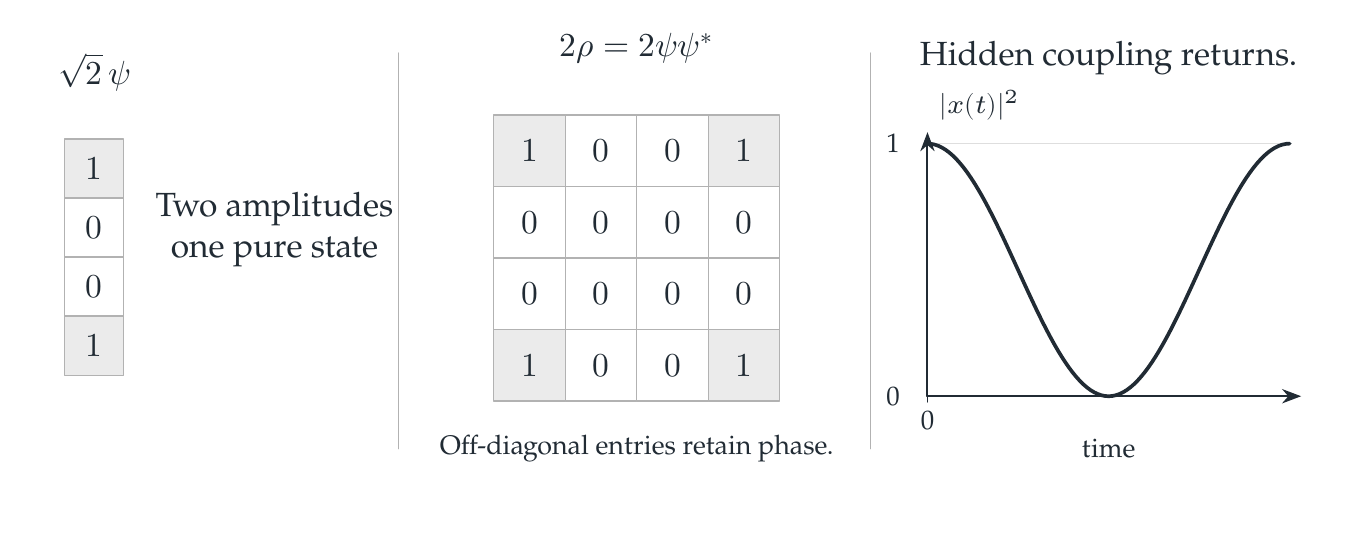
Read left to right: the Bell amplitudes occupy the first and last addresses; the corresponding density matrix also has off-diagonal entries. The separate right-hand dynamics panel shows a retained probability leaving and later returning.
Drawing labels and data 30 labels
Read the original labels as selectable text. Tables preserve grid relationships; other short labels are grouped compactly.
- \(\sqrt2\,\psi\)
- \(1\)
- \(0\)
- \(0\)
- \(1\)
Two amplitudes
one pure state
- \(2\rho=2\psi\psi^*\)
| Row / column | Column 1 | Column 2 | Column 3 | Column 4 |
|---|---|---|---|---|
| Row 1 | \(1\) | \(0\) | \(0\) | \(1\) |
| Row 2 | \(0\) | \(0\) | \(0\) | \(0\) |
| Row 3 | \(0\) | \(0\) | \(0\) | \(0\) |
| Row 4 | \(1\) | \(0\) | \(0\) | \(1\) |
- Off-diagonal entries retain phase.
- 0
- 0
- 1
- time
- \(|x(t)|^2\)
- Hidden coupling returns.
Amplitudes retain relative phase
For the Bell vector \(\psi=({\left|00\right\rangle}+{\left|11\right\rangle})/\sqrt2\), the two nonzero entries are amplitudes. The density matrix \(\rho=\psi\psi^*\) also records coherence in its off-diagonal entries. Measurements that compare the two addresses can detect this coherence. Deleting those entries applies a physical channel and changes the state.
How hidden dynamics returns
When a Hamiltonian couples a retained state to a hidden state, the retained amplitude can leave and later return. Its exact equation then remembers the hidden coupling. A smaller matrix obtained by deleting rows and columns does not generally reproduce that equation.
A route through the paper
Pages Visual 3–Visual 10 develop seeds, symmetry, and coherent circuit paths. Pages Visual 11–Visual 15 track leakage and moving subspaces. Pages Visual 16–Visual 20 distinguish measurement, channels, and recovery. Pages Visual 21–Visual 27 follow hidden dynamics and finite geometric diagnostics.
Read this guide alongside the traditional volume. The first 28 worked pages retain the original appendix's examples and mathematical content, with source references updated to this edition. Pages Visual 29–Visual 40 develop additional strengthened results. The example checks and the inherited Lean certificates have separately recorded scopes.
Read this as
A packet coordinate change preserves information. A measurement, dephasing operation, or truncation may not. Always identify which operation is actually being performed.