
On the unit sphere, set \(n=(\sin\theta\cos\phi,\sin\theta\sin\phi,\cos\theta)\) and
This is a smooth rank-one orthogonal projector. The intrinsic curvature is the endomorphism-valued two-form \(P({\,\mathrm d} P\wedge{\,\mathrm d} P)P\). With the paper's scalar convention, its component is
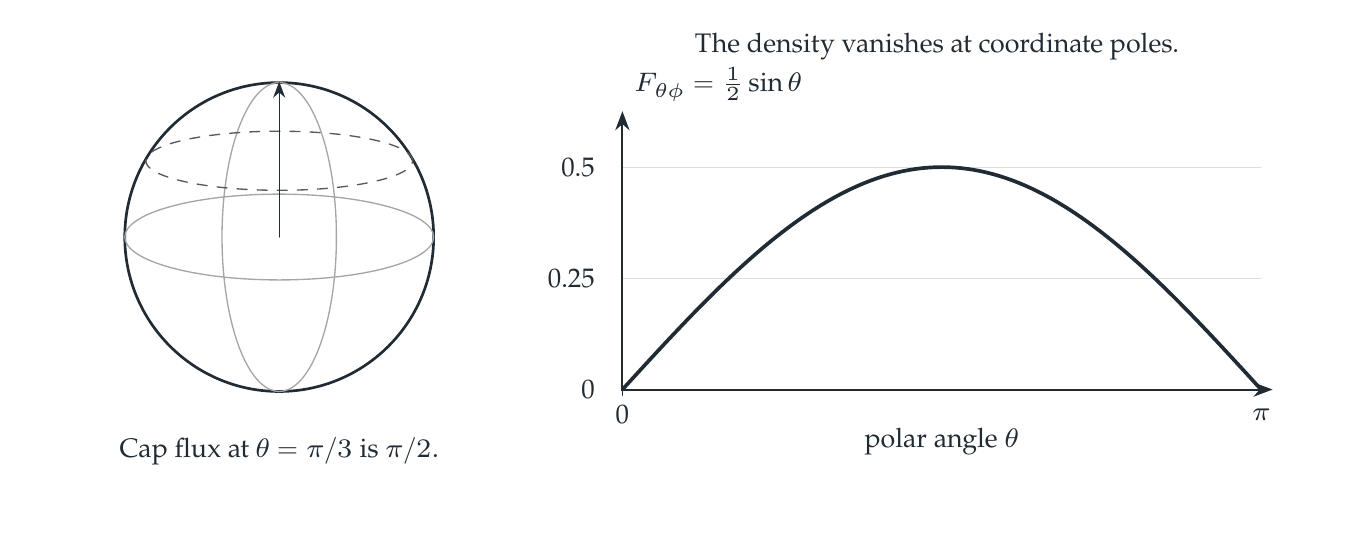
Reading the drawing
The sphere at left marks a latitude and cap. The curve at right plots the displayed density against polar angle and vanishes at both coordinate poles. The cap-flux annotation gives the exact example value.
Drawing labels and data 9 labels
Read the original labels as selectable text. Tables preserve grid relationships; other short labels are grouped compactly.
- Cap flux at \(\theta=\pi/3\) is \(\pi/2\).
- 0
- 0
- 0.25
- 0.5
- polar angle \(\theta\)
\(F_{\theta\phi}=\frac12\sin\theta\)
- \(\pi\)
- The density vanishes at coordinate poles.
A local frame gives the same answer
Away from the south pole, use \(u_N=(\cos(\theta/2),e^{{\mathrm i}\phi}\sin(\theta/2))^T\). Then \(P=u_Nu_N^*\) and the scalar one-form is
Thus the curvature flux through the cap \(0\le\theta\le\theta_0\) is \(\pi(1-\cos\theta_0)\). At \(\theta_0=\pi/3\), it is exactly \(\pi/2\). The latitude drawn in the plate illustrates this cap. The exact flux comes from the formula above.
The vanishing of the coordinate density at a pole does not mean the geometric curvature disappears there. The spherical area form also carries the factor \(\sin\theta\). Assigning a phase to parallel transport also requires an orientation and a sign convention for the connection. These choices determine how flux relates to phase.
Read this as
The projector formula and a local frame calculation agree. Curvature is intrinsic even when no single smooth frame covers the whole sphere.