
Take the self-adjoint matrices
Both constraints annihilate \(P{\mathbb C}^3\), and their common kernel is exactly that one-dimensional space. Nevertheless, their full commutator is nonzero.
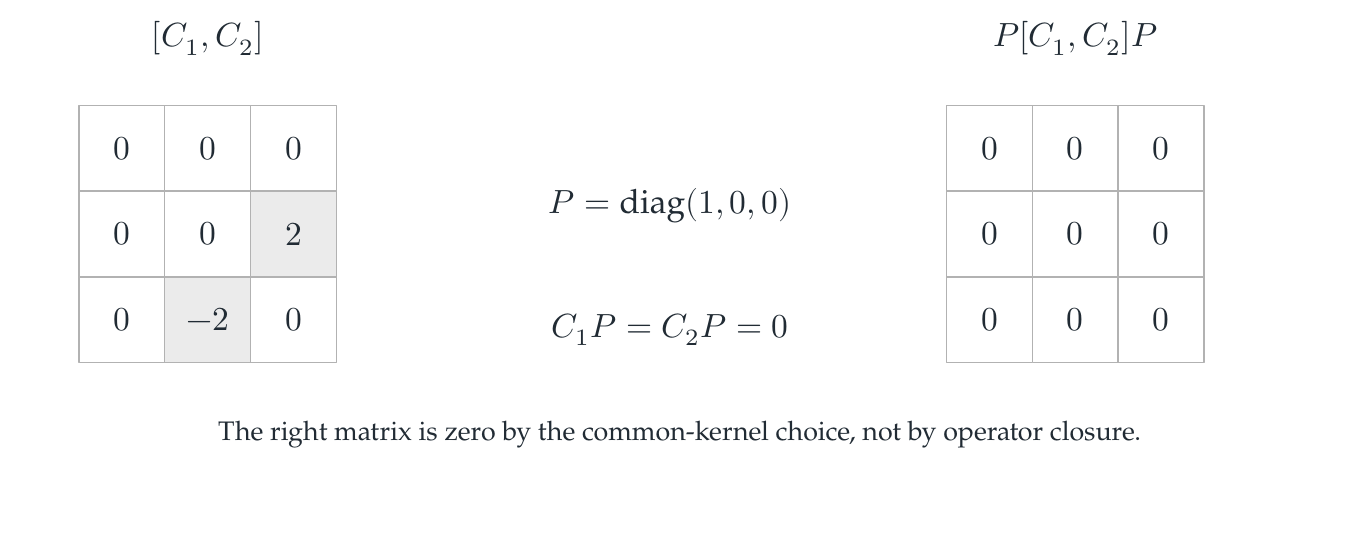
Reading the drawing
The left matrix is the full constraint commutator. The middle annotations identify the common-kernel projector and the constraints that kill its range. The right matrix is the compressed commutator; the note explains the scope of its vanishing.
Drawing labels and data 23 labels
Read the original labels as selectable text. Tables preserve grid relationships; other short labels are grouped compactly.
- \([C_1,C_2]\)
| Row / column | Column 1 | Column 2 | Column 3 |
|---|---|---|---|
| Row 1 | \(0\) | \(0\) | \(0\) |
| Row 2 | \(0\) | \(0\) | \(2\) |
| Row 3 | \(0\) | \(-2\) | \(0\) |
- \(P[C_1,C_2]P\)
| Row / column | Column 1 | Column 2 | Column 3 |
|---|---|---|---|
| Row 1 | \(0\) | \(0\) | \(0\) |
| Row 2 | \(0\) | \(0\) | \(0\) |
| Row 3 | \(0\) | \(0\) | \(0\) |
- \(P={\operatorname{diag}}(1,0,0)\)
- \(C_1P=C_2P=0\)
The right matrix is zero by the common-kernel choice, not by operator closure.
Why the compressed test cannot decide closure
Since \(C_1P=C_2P=0\), each product \(C_1C_2P\) and \(C_2C_1P\) vanishes. Therefore \(P[C_1,C_2]P=0\) without any requirement that the unprojected commutator close in the chosen constraint span. In this example the skew off-diagonal commutator is not a linear combination of the two displayed symmetric constraints.
More generally, an anomaly expression made from their commutators and linear combinations of constraints also kills an exact projector onto the common kernel on the right. The formal release records this limit of the diagnostic. A nonzero compressed residual can reveal inconsistent proposed data, but an automatic zero does not construct an anomaly-free constraint algebra.
A substantive closure analysis must inspect the operator relations, their domains, the actual physical subspace, and compatibility under refinement. For infinite systems, these questions also involve domain and limit control that finite matrix arithmetic cannot replace.
The exact example computes both constraint products, the full commutator, and its compression. It deliberately rejects the inference from compressed zero to unprojected zero.
Read this as
Before interpreting a vanishing residual, check whether the definition of its projector already forces it to vanish. A tautological diagnostic cannot supply the missing existence or closure theorem.