
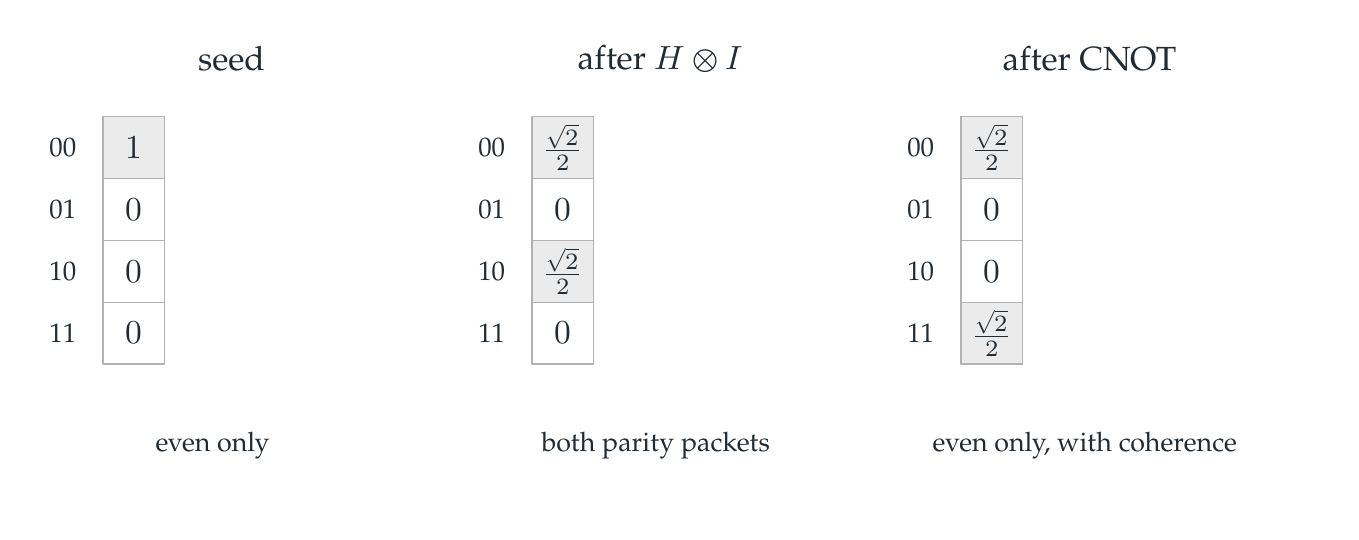
The input is \({\left|00\right\rangle}\). First apply a Hadamard to the first qubit, then a controlled flip:
The displayed columns keep amplitudes, including their normalization, at every step. The middle vector occupies both parity packets. The final vector occupies only the even packet.
Reading the drawing
Read the columns from the seed through the Hadamard step to the controlled-NOT step. Address labels fix the row order. The notes below identify which parity packets are occupied at each stage, including the coherence in the final even packet.
Drawing labels and data 30 labels
Read the original labels as selectable text. Tables preserve grid relationships; other short labels are grouped compactly.
- seed
- \(1\)
- \(0\)
- \(0\)
- \(0\)
- 00
- 01
- 10
- 11
- after \(H\otimes I\)
\(\frac{\sqrt{2}}{2}\)
- \(0\)
\(\frac{\sqrt{2}}{2}\)
- \(0\)
- 00
- 01
- 10
- 11
- after CNOT
\(\frac{\sqrt{2}}{2}\)
- \(0\)
- \(0\)
\(\frac{\sqrt{2}}{2}\)
- 00
- 01
- 10
- 11
- even only
- both parity packets
- even only, with coherence
How the exact path expansion works
Insert \(P_{\rm even}+P_{\rm odd}=I\) between the two gates. Each summand records a particular intermediate packet, while the boundary projectors select its input and output packets. Summing all terms recovers the original \(4\times4\) circuit matrix:
This expansion is an identity even though the intermediate parity is not measured. Physically inserting a measurement would alter the problem by removing interference between its alternatives. The derivation resolves intermediate coordinates without physically measuring them.
In the finite check, all eight matrix terms indexed by parity are constructed and summed. The matrix equality is checked before specializing to the input vector. It therefore verifies the decomposition for every input of this example, not merely agreement on the Bell seed.
Read this as
A final invariant packet does not imply that each preceding gate preserved it. Follow the amplitudes through the actual intermediate resolutions.