
Consider \(M_2({\mathbb C})\otimes I_3\) acting on \({\mathbb C}^2\otimes{\mathbb C}^3\). A seed is a \(2\times3\) coefficient matrix. Its two rows span at most two directions in the three-dimensional multiplicity factor. Therefore no single seed is cyclic for this algebra.
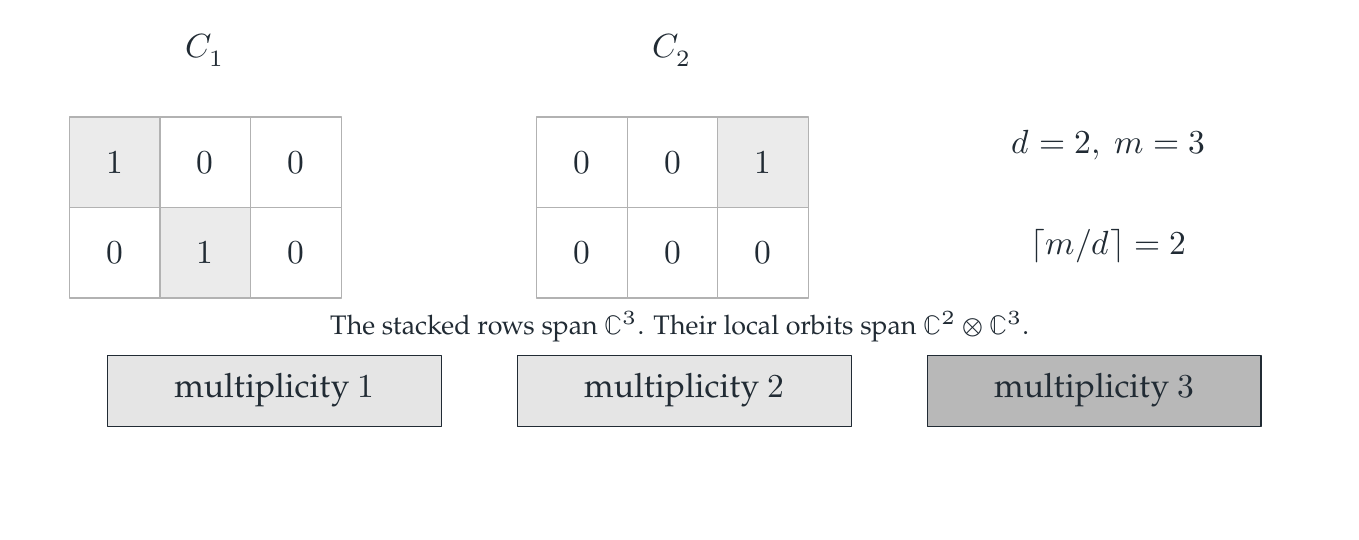
These two matrices provide a complete set of row directions. Their individual orbit dimensions are four and two, and together those spans fill the six-dimensional state space.
Reading the drawing
The first seed supplies the first two row directions and the second supplies the third. Three boxes below represent the multiplicity directions; the right-hand annotation gives the seed-count bound for this example.
Drawing labels and data 20 labels
Read the original labels as selectable text. Tables preserve grid relationships; other short labels are grouped compactly.
- \(C_1\)
| Row / column | Column 1 | Column 2 | Column 3 |
|---|---|---|---|
| Row 1 | \(1\) | \(0\) | \(0\) |
| Row 2 | \(0\) | \(1\) | \(0\) |
- \(C_2\)
| Row / column | Column 1 | Column 2 | Column 3 |
|---|---|---|---|
| Row 1 | \(0\) | \(0\) | \(1\) |
| Row 2 | \(0\) | \(0\) | \(0\) |
- \(d=2,\ m=3\)
- \(\lceil m/d\rceil=2\)
- multiplicity \(1\)
- multiplicity \(2\)
- multiplicity \(3\)
The stacked rows span \({\mathbb C}^3\). Their local orbits span \({\mathbb C}^2\otimes{\mathbb C}^3\).
From the example to the finite formula
For a block \(M_d({\mathbb C})\otimes I_m\), \(k\) seed matrices contribute at most \(kd\) independent multiplicity directions. Hence \(k\ge\lceil m/d\rceil\). Partitioning a multiplicity basis into groups of size at most \(d\) attains this bound. For a direct sum of such blocks, the worst block determines the required count:
This is an invariant of the declared representation of the algebra, and depends on more than the dimension of the Hilbert space alone. If the available algebra were enlarged to the full matrix algebra on \({\mathbb C}^6\), every nonzero seed would instead be cyclic.
The example checks both the ranks of the separate coefficient matrices and the rank three of their stacked row matrix. The argument explains why the construction meets the lower bound and therefore proves minimality.
Read this as
Missing multiplicity directions cannot be created by reusing the same left action. Adding seeds and enlarging the operator algebra provide different ways to supply those directions.