
Continue with \(P(t)=U(t){\operatorname{diag}}(1,0)U(t)^*\) and \(Q(t)=I-P(t)\). Differentiating \(P^2=P\) gives
The second identity says that the derivative has no component entirely inside the current packet. It moves the subspace relative to its complement.
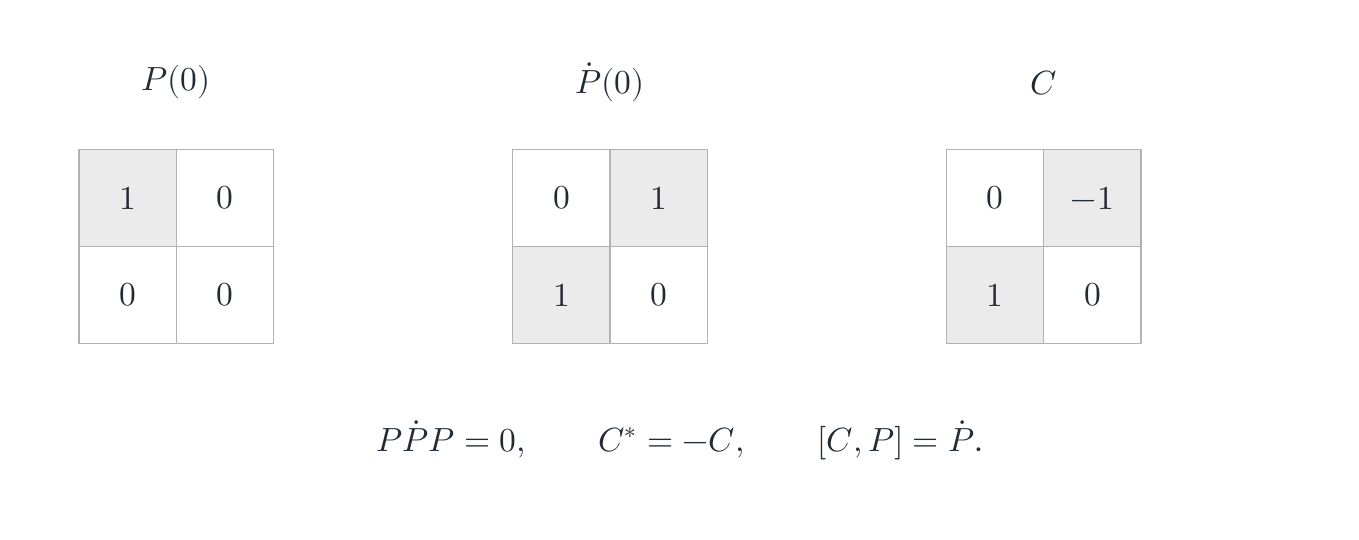
Reading the drawing
Read the matrices from left to right at the same parameter value. The identities below state the tangent condition, skew-adjointness, and the commutator relation retained in the source drawing.
Drawing labels and data 16 labels
Read the original labels as selectable text. Tables preserve grid relationships; other short labels are grouped compactly.
- \(P(0)\)
| Row / column | Column 1 | Column 2 |
|---|---|---|
| Row 1 | \(1\) | \(0\) |
| Row 2 | \(0\) | \(0\) |
- \(\dot P(0)\)
| Row / column | Column 1 | Column 2 |
|---|---|---|
| Row 1 | \(0\) | \(1\) |
| Row 2 | \(1\) | \(0\) |
- \(C\)
| Row / column | Column 1 | Column 2 |
|---|---|---|
| Row 1 | \(0\) | \(-1\) |
| Row 2 | \(1\) | \(0\) |
- \(P\dot P P=0,\qquad C^*=-C,\qquad[C,P]=\dot P\).
For this complete pair of packets, define
Exact calculation yields the constant matrix \(C=J\), with \(C^*=-C\) and \([C,P]=\dot P\). At \(t=0\), the displayed small matrices allow these identities to be checked by direct multiplication.
From two packets to a complete family
For differentiable orthogonal projectors \(P_a\) summing to the identity, the paper constructs
This single connection reproduces the motion of every packet in the family. No basis within a packet is needed for this formula. A basis choice would add internal coordinate data without changing which subspaces are selected.
The completeness of the family matters in deriving skew-Hermiticity and the simultaneous transport identities. Using only one summand of an incomplete list is not automatically the same connection. The example retains both \(P\) and \(Q\) throughout, even when the picture emphasizes only the first line.
Read this as
The projector derivative describes motion between subspaces. The canonical connection reconstructs that motion from the complete family without choosing internal packet bases.