
For the exact route, let \({\mathcal H}_n={\mathbb C}^n\) with coordinate inclusions and
The old energies are retained at every level, \(H_{n+1}R_n=R_nH_n\), and \({\left\lVert H_n\right\rVert}\leq1\). On the Hilbert space of the direct limit \(\ell^2({\mathbb N}_0)\), the diagonal sequence defines a bounded self-adjoint \(H_\infty\). Projectors onto even addresses also intertwine and give a fixed complete system of two packets in the limit.
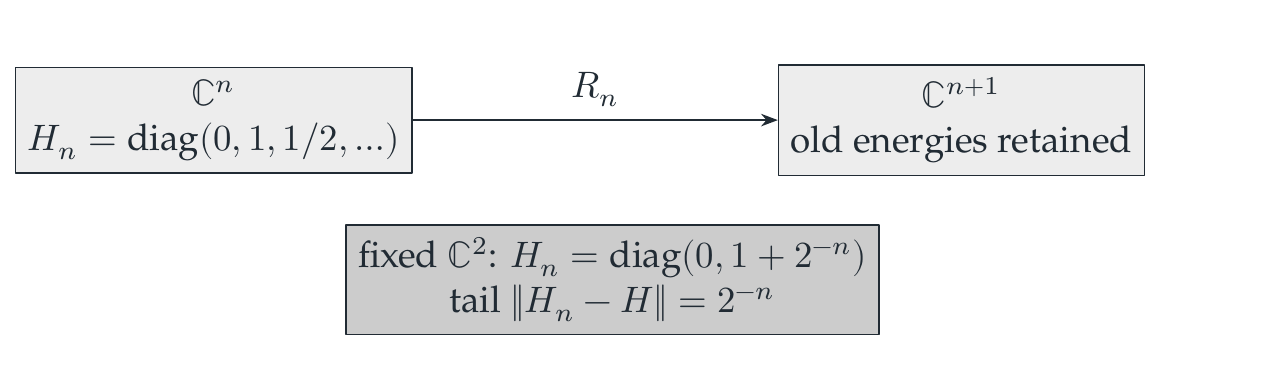
Reading the drawing
The upper arrow embeds one coordinate space into the next while retaining the old energies. The lower box gives a different construction on one fixed two-dimensional space and its displayed norm error. The plate keeps the hypotheses of these routes separate.
Drawing labels and data 4 labels
Read the original labels as selectable text. Tables preserve grid relationships; other short labels are grouped compactly.
\({\mathbb C}^n\)
\(H_n=\operatorname{diag}(0,1,1/2,\ldots)\)
\({\mathbb C}^{n+1}\)
old energies retained
- \(R_n\)
fixed \({\mathbb C}^2\): \(H_n=\operatorname{diag}(0,1+2^{-n})\)
tail \(\|H_n-H\|=2^{-n}\)
Compatibility and boundedness are different assumptions
The equally compatible tower \({\operatorname{diag}}(0,1,2,\ldots,n-1)\) has growing norms. It does not satisfy the bounded direct limit theorem. Its natural diagonal operator needs a separately specified domain. Dropping the uniform norm hypothesis does not supply that domain argument.
For the norm route, work instead on the single fixed space \({\mathbb C}^2\) and set
Here \({\left\lVert H_{n+1}-H_n\right\rVert}=2^{-(n+1)}\) and \({\left\lVert H_n-H\right\rVert}=2^{-n}\). The summable tail supplies an error bound for every \(n\). For \(|t|\leq T\), the paper's Duhamel estimate gives
The Euclidean counterpart holds on \(0\leq t\leq T\) because both Hamiltonians are nonnegative. If packet projectors also converge in norm, leakage operators converge uniformly on these time intervals.
Execution scope
Exact inclusions and projector compatibility are checked through level eight. The two-dimensional tail identities are checked for \(n=0,\ldots,12\). Their infinite conclusion uses the displayed geometric series and the theorem's analytic estimate. A finite prefix cannot certify an unspecified continuation of a tower.
Read this as
Exact embedded compatibility uses a uniform norm bound. Approximate convergence uses a common space and summable defects. Keep the hypotheses of these two routes explicit.