
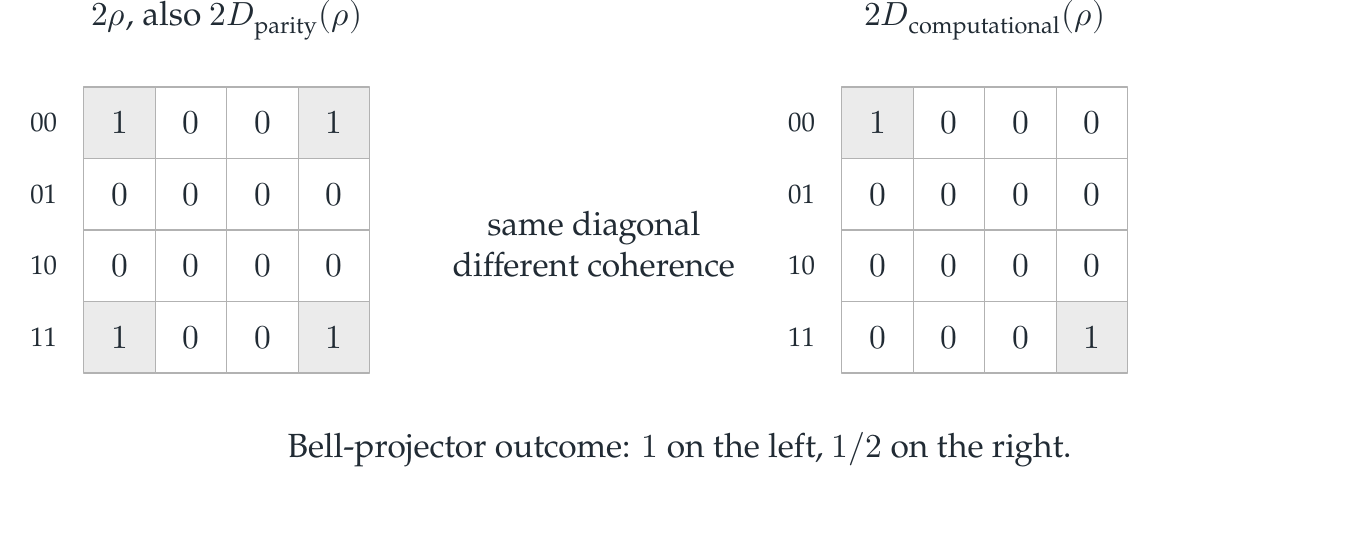
For the Bell density matrix \(\rho={\left|\Phi^+\right\rangle}{\left\langle\Phi^+\right|}\), parity dephasing does nothing: both nonzero amplitudes already lie in the even subspace. Dephasing in the computational basis removes the entries between addresses \(00\) and \(11\).
Reading the drawing
The left matrix retains the Bell coherence under parity dephasing. The right matrix removes it under computational dephasing. The middle and bottom notes compare their diagonals and the Bell-projector outcome.
Drawing labels and data 44 labels
Read the original labels as selectable text. Tables preserve grid relationships; other short labels are grouped compactly.
- \(2\rho\), also \(2D_{\rm parity}(\rho)\)
| Row / column | Column 1 | Column 2 | Column 3 | Column 4 |
|---|---|---|---|---|
| 00 | \(1\) | \(0\) | \(0\) | \(1\) |
| 01 | \(0\) | \(0\) | \(0\) | \(0\) |
| 10 | \(0\) | \(0\) | \(0\) | \(0\) |
| 11 | \(1\) | \(0\) | \(0\) | \(1\) |
- \(2D_{\rm computational}(\rho)\)
| Row / column | Column 1 | Column 2 | Column 3 | Column 4 |
|---|---|---|---|---|
| 00 | \(1\) | \(0\) | \(0\) | \(0\) |
| 01 | \(0\) | \(0\) | \(0\) | \(0\) |
| 10 | \(0\) | \(0\) | \(0\) | \(0\) |
| 11 | \(0\) | \(0\) | \(0\) | \(1\) |
same diagonal
different coherence
Bell-projector outcome: \(1\) on the left, \(1/2\) on the right.
Every effect in the computational basis \(E_a={\left|a\right\rangle}{\left\langle a\right|}\) has the same expectation on both matrices, namely \(1/2\) at \(00\) and \(11\) and zero elsewhere. These measurements read only the diagonal. They cannot distinguish the pure Bell state from this incoherent mixture.
A measurement that resolves the difference
Use the valid two-outcome measurement with effects \(E=\rho\) and \(I-E\). Then
The effect itself is not diagonal in the fine computational packets. It compares their coherent combination, so it falls outside the paper's invariance result for block-diagonal effects.
This example contains three operations that should not be conflated: representing a state by all of its packet matrix blocks, applying a dephasing channel, and reading one specified measurement. Only the second discards the off-diagonal blocks. The third may or may not notice that loss, depending on its effects.
The exact checks construct all four fine projectors, both parity projectors, both dephased states, and the outcome traces. They reject the stronger statement that every measurement is invariant under dephasing.
Read this as
A measurement's inability to see a coherence does not make that coherence absent. It states a restriction on the observable, not an equality of the underlying states.