
Write a bipartite vector as a coefficient matrix \(C\), with the first subsystem indexing rows. Acting only on that subsystem transforms \(C\) to \(AC\). Every resulting row remains in the row space of \(C\), and every independent choice of such rows can be obtained in this way.
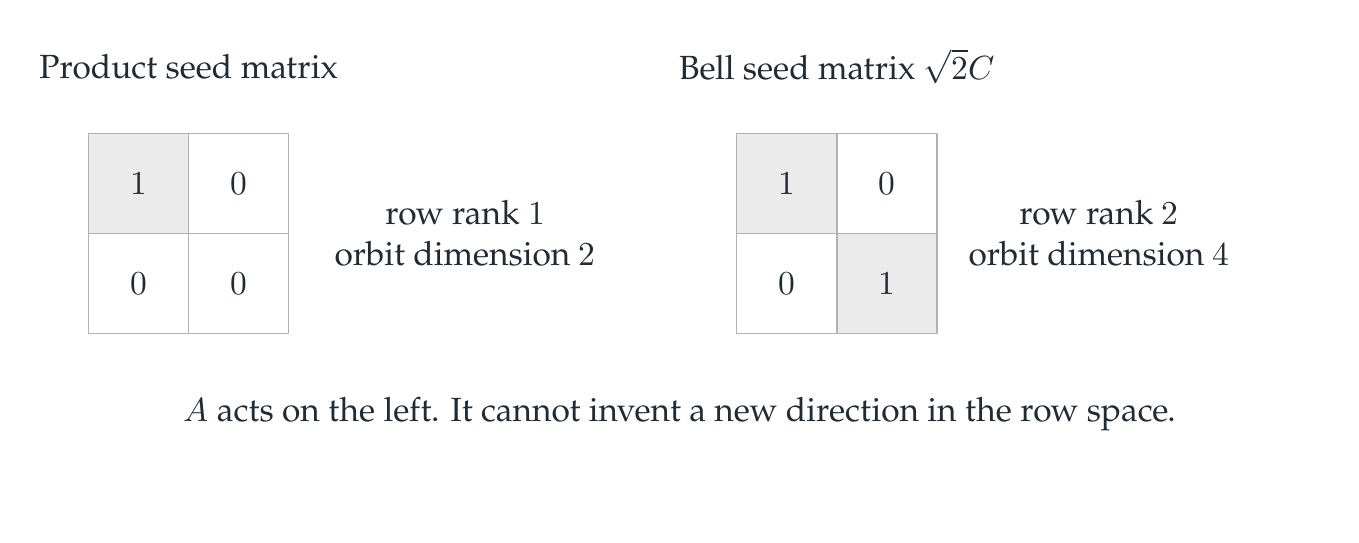
Reading the drawing
The left coefficient matrix has one nonzero row direction and the right matrix has two. The adjacent annotations give the corresponding local orbit dimensions. The action is on the left of each matrix, as the original note states.
Drawing labels and data 13 labels
Read the original labels as selectable text. Tables preserve grid relationships; other short labels are grouped compactly.
- Product seed matrix
| Row / column | Column 1 | Column 2 |
|---|---|---|
| Row 1 | \(1\) | \(0\) |
| Row 2 | \(0\) | \(0\) |
- Bell seed matrix \(\sqrt2C\)
| Row / column | Column 1 | Column 2 |
|---|---|---|
| Row 1 | \(1\) | \(0\) |
| Row 2 | \(0\) | \(1\) |
row rank \(1\)
orbit dimension \(2\)
row rank \(2\)
orbit dimension \(4\)
\(A\) acts on the left. It cannot invent a new direction in the row space.
The product vector \({\left|00\right\rangle}\) has matrix \(C={\operatorname{diag}}(1,0)\). Its local orbit span allows arbitrary vectors in the first subsystem but only the second subsystem direction \({\left|0\right\rangle}\), so its dimension is two. The Bell vector has \(C=I/\sqrt2\), rank two, and a four-dimensional local orbit span.
What the formula does not say
The action here allows arbitrary matrices and then takes a linear span. It is not the orbit under local unitary gates alone. Local unitary operations preserve Schmidt coefficients. They therefore cannot turn the Bell vector into an arbitrary product vector by a deterministic transformation between pure states.
For the exact calculation, apply the four matrix units \(E_{ab}\) to each seed matrix, flatten the outputs, and compute their column rank. The observed dimensions are two and four, respectively. The calculation directly exhibits the independent rows counted by the theorem.
Read this as
Schmidt rank measures the remote multiplicity directions accessible to the local operator span. It is not permission for unrestricted deterministic local state preparation.