
Take the exact rational Hamiltonian
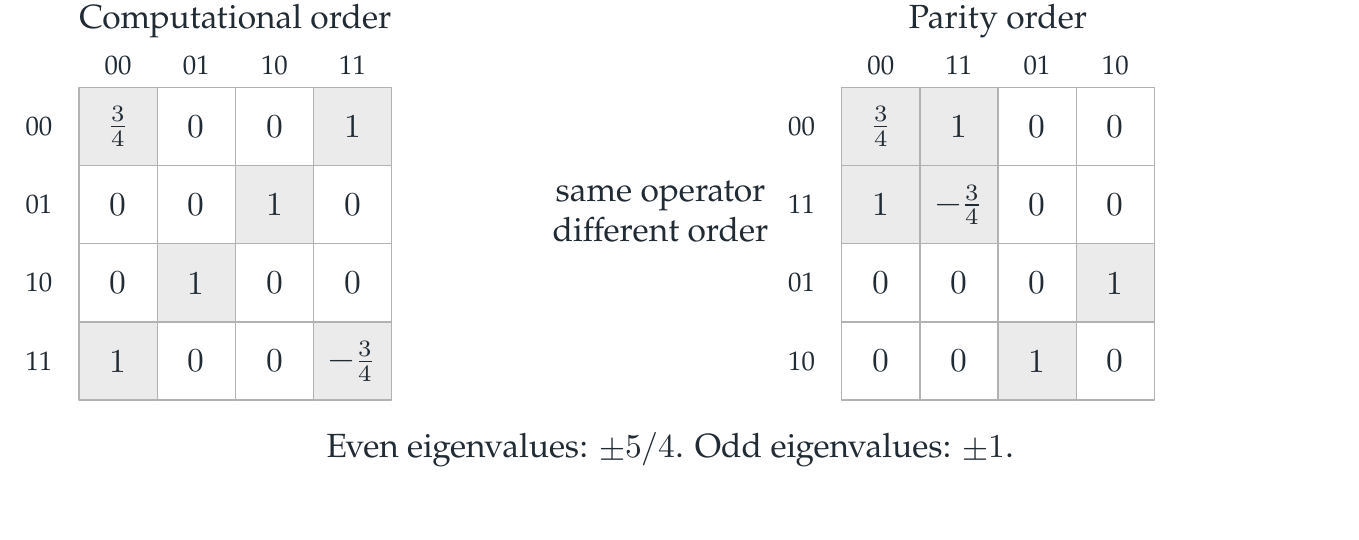
It commutes with total parity \(Z\otimes Z\). Reordering the computational basis into even addresses \((00,11)\) and odd addresses \((01,10)\) displays the invariant subspaces explicitly.
Reading the drawing
The address labels show the row and column permutation. The reordered matrix displays two blocks, while the middle note identifies the two matrices as the same operator. The bottom annotation lists the two sector spectra.
Drawing labels and data 52 labels
Read the original labels as selectable text. Tables preserve grid relationships; other short labels are grouped compactly.
- Computational order
| Row / column | 00 | 01 | 10 | 11 |
|---|---|---|---|---|
| 00 | \(\frac{3}{4}\) | \(0\) | \(0\) | \(1\) |
| 01 | \(0\) | \(0\) | \(1\) | \(0\) |
| 10 | \(0\) | \(1\) | \(0\) | \(0\) |
| 11 | \(1\) | \(0\) | \(0\) | \(- \frac{3}{4}\) |
- Parity order
| Row / column | 00 | 11 | 01 | 10 |
|---|---|---|---|---|
| 00 | \(\frac{3}{4}\) | \(1\) | \(0\) | \(0\) |
| 11 | \(1\) | \(- \frac{3}{4}\) | \(0\) | \(0\) |
| 01 | \(0\) | \(0\) | \(0\) | \(1\) |
| 10 | \(0\) | \(0\) | \(1\) | \(0\) |
same operator
different order
Even eigenvalues: \(\pm5/4\). Odd eigenvalues: \(\pm1\).
The even block squares to \((25/16)I\), so its eigenvalues are \(\pm5/4\). The odd block squares to \(I\), so its eigenvalues are \(\pm1\). Exponentiating either block gives the corresponding part of the exact evolution. Transfer between the packets remains zero for every real time.
What has changed?
Only the order of basis vectors has changed. No matrix entries, amplitudes, or energy levels were discarded. This is why the decomposition is exact. Keeping just the even block would be a separate restriction of the state space, justified for initial data known to be even and for dynamics that preserve it.
The next page breaks a symmetry in a smaller model. There the entries coupling the packets no longer vanish, so their effect needs an explicit bound. The exact tests here multiply the commutator, verify the displayed permutation, and compute all four eigenvalues symbolically.
Read this as
Block diagonalization uses an invariant decomposition already present in the operator. It is not evidence that an arbitrary chosen packet is invariant.