
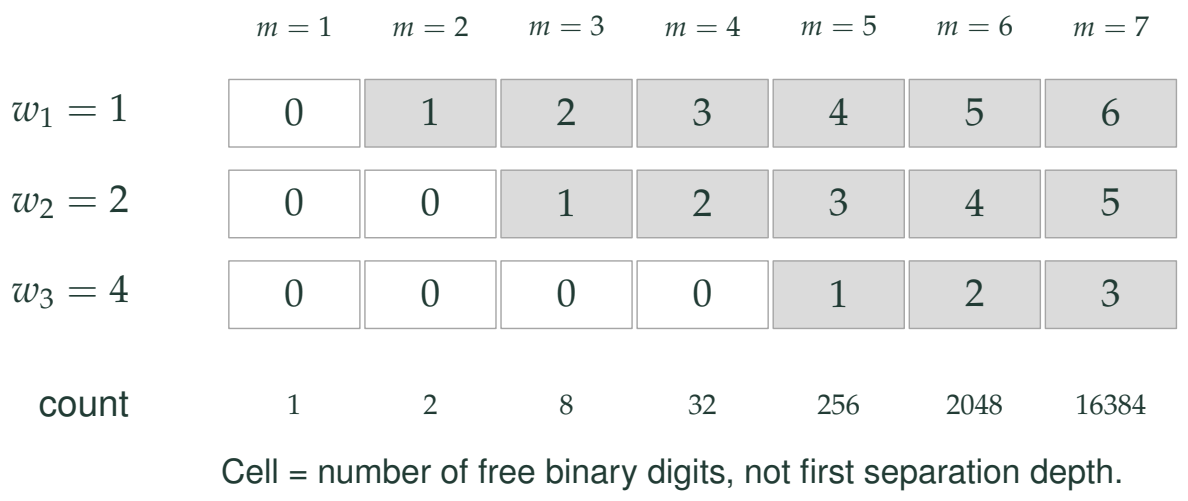
Over \({\mathbb Z}_2\), require three coordinates to lie in \(2{\mathbb Z}_2\), \(2^2{\mathbb Z}_2\), and \(2^4{\mathbb Z}_2\). At depth \(m\), coordinate \(i\) has \(\max(m-w_i,0)\) free binary digits. A zero in the table means only one allowed residue: zero.
Reading the drawing
Columns are precision depths and rows are coordinate weights one, two and four. An entry counts free binary digits, with zero meaning one allowed residue. The bottom row gives the total point count. Visibility begins at different depths for the three coordinates.
Drawing labels and data 40 labels
Read the original labels as selectable text. Tables preserve grid relationships; other short labels are grouped compactly.
| Row / column | \(m=1\) | \(m=2\) | \(m=3\) | \(m=4\) | \(m=5\) | \(m=6\) | \(m=7\) |
|---|---|---|---|---|---|---|---|
| \(w_1=1\) | \(0\) | \(1\) | \(2\) | \(3\) | \(4\) | \(5\) | \(6\) |
| \(w_2=2\) | \(0\) | \(0\) | \(1\) | \(2\) | \(3\) | \(4\) | \(5\) |
| \(w_3=4\) | \(0\) | \(0\) | \(0\) | \(0\) | \(1\) | \(2\) | \(3\) |
- count
- \(1\)
- \(2\)
- \(8\)
- \(32\)
- \(256\)
- \(2048\)
- \(16384\)
Cell = number of free binary digits, not first separation depth.
The two different thresholds
A coordinate of weight \(w_i\) first becomes nontrivial when \(m=w_i+1\). By contrast, the first separation depth of two distinct fixed values \(a,b\) is \(v_2(a-b)+1\). Thus \(1\) and \(-1\) separate at depth two, because their difference has valuation one. Neither threshold is simply the printed coordinate label.
For weights \((1,2,4)\),
The first counts are \(1,2,8,32,256,2048\). Once all three coordinates are active, every additional precision digit multiplies the count by eight. Separating the initial levels from that geometric tail gives
Negative coefficients in the numerator do not mean negative numbers of points; expanding the whole rational expression gives positive coefficients.
Read this as
Weights change the finite-depth delay. After activation, this chart still has three independent digit streams.