
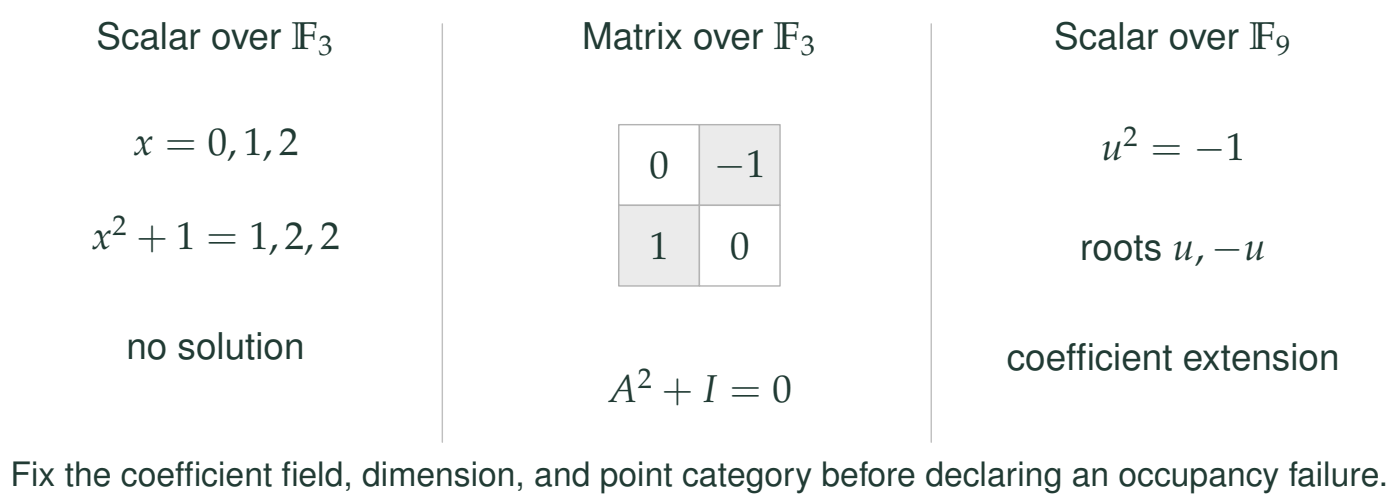
Over \({\mathbb F}_3\), no scalar solves \(x^2+1=0\). But the matrix
And over \({\mathbb F}_9={\mathbb F}_3[u]/(u^2+1)\), the scalars \(u\) and \(-u\) solve the same polynomial.
Reading the drawing
The three panels change the allowed object: scalars over the field with three elements, two-by-two matrices over that field, and scalars over its quadratic extension. The differing answers are compatible because the coefficient category and dimension differ.
Drawing labels and data 15 labels
Read the original labels as selectable text. Tables preserve grid relationships; other short labels are grouped compactly.
Scalar over \(\mathbb F_3\)
- \(x=0,1,2\)
- \(x^2+1=1,2,2\)
- no solution
Matrix over \(\mathbb F_3\)
| Row / column | Column 1 | Column 2 |
|---|---|---|
| Row 1 | \(0\) | \(-1\) |
| Row 2 | \(1\) | \(0\) |
- \(A^2+I=0\)
Scalar over \(\mathbb F_9\)
- \(u^2=-1\)
- roots \(u,-u\)
- coefficient extension
Fix the coefficient field, dimension, and point category before declaring an occupancy failure.
Three outputs with different types
The failed scalar problem over \({\mathbb F}_3\), the successful matrix problem over \({\mathbb F}_3\), and the successful scalar problem over \({\mathbb F}_9\) are not contradictory answers. They have different allowed objects. The matrix is multiplication by \(u\) in the \({\mathbb F}_3\)-basis \((1,u)\) of the extension field.
This also has a characteristic-zero analogue. The matrix with the same entries gives a rational two-dimensional representation of a cyclic group of order four. Its scalar eigenvalues require a field containing a square root of \(-1\). No one-dimensional rational eigencharacter is created by writing the two-dimensional matrix.
Accordingly, the scalar companion failure on page Visual 8 is a counterexample only to the fixed scalar problem. It is not a counterexample to a representation problem that permits coefficient extension or a different dimension. Those permissions must be declared before comparing fibers across primes.
Read this as
An empty fiber is meaningful only after its coefficient ring and object type are fixed. Do not repair an empty fiber by silently changing either.