
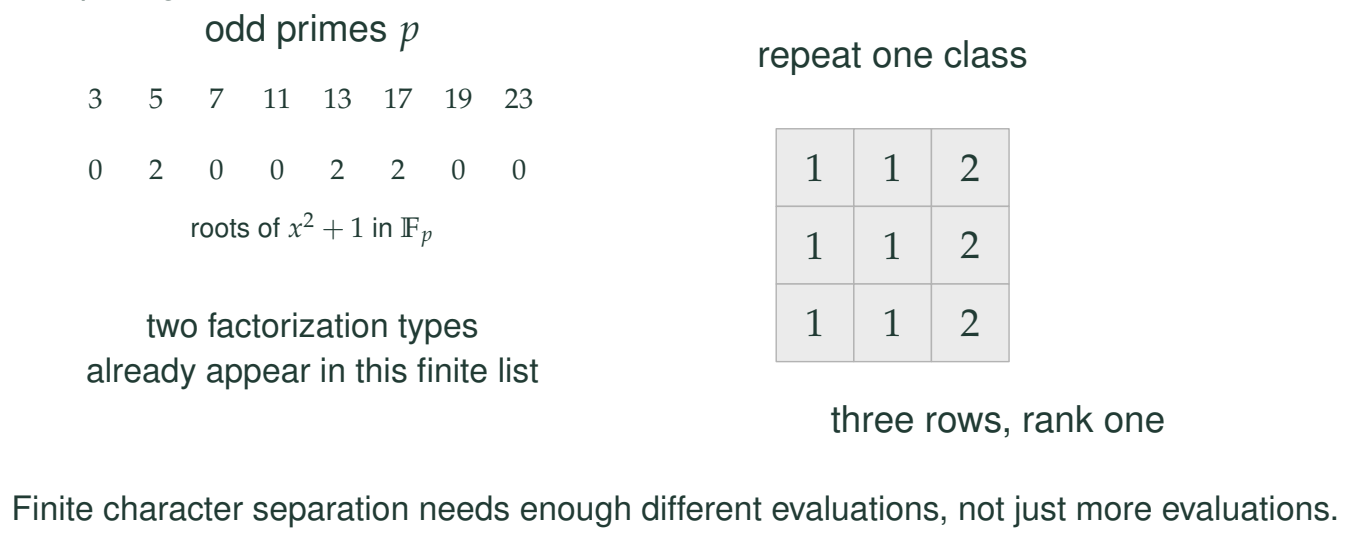
For the quadratic polynomial \(X^2+1\), reduction modulo an odd prime either gives two roots or no roots. This finite scan displays both behaviors. It is a useful model for the distinction between splitting and nonsplitting classes.
Reading the drawing
The displayed primes are classified by the scalar roots of the quadratic polynomial. Both splitting behaviors occur in this finite window. The scan supplies no quantifier over arbitrary finite exclusions and no density or infinitude conclusion.
Drawing labels and data 31 labels
Read the original labels as selectable text. Tables preserve grid relationships; other short labels are grouped compactly.
- \(3\)
- \(0\)
- \(5\)
- \(2\)
- \(7\)
- \(0\)
- \(11\)
- \(0\)
- \(13\)
- \(2\)
- \(17\)
- \(2\)
- \(19\)
- \(0\)
- \(23\)
- \(0\)
- odd primes \(p\)
roots of \(x^2+1\) in \(\mathbb F_p\)
two factorization types
already appear in this finite list
- repeat one class
| Row / column | Column 1 | Column 2 | Column 3 |
|---|---|---|---|
| Row 1 | \(1\) | \(1\) | \(2\) |
| Row 2 | \(1\) | \(1\) | \(2\) |
| Row 3 | \(1\) | \(1\) | \(2\) |
- three rows, rank one
Finite character separation needs enough different evaluations, not just more evaluations.
Existence must survive arbitrary exclusions
The continuation's missing general coverage proposition asks for an actual unramified rational prime in a prescribed conjugacy class, outside any prescribed finite forbidden set, together with the corresponding absolute Frobenius witness. A list of small primes does not establish that quantifier.
The finite character argument on page Visual 15 also needs samples that jointly separate the constituents. Repeating the identity-class row \((1,1,2)\) of the \(S_3\) table gives rank one no matter how often it is repeated. Many samples are not necessarily informative samples.
The later checked rational-base separator composes its constructed arithmetic coverage theorem with finite linear algebra. The earlier scalar/Mellin route retained a coverage premise. The displayed scan certifies neither route: it is a finite example, not an occurrence theorem.
Read this as
A separating group element, a witnessed Frobenius at one prime, and a new prime after every finite exclusion are distinct levels of evidence.
Evidence note from the source edition
The scan exhaustively checks scalar roots for the shown primes. No density, infinitude, or general prescribed-conjugacy statement is inferred from it.