
Consider the fixed scalar equation \(x^2+1=0\) in \({\mathbb Z}/p^m{\mathbb Z}\). The following are exact counts for five primes and three depths. The coefficient rings and the scalar nature of the unknown are fixed throughout this page.
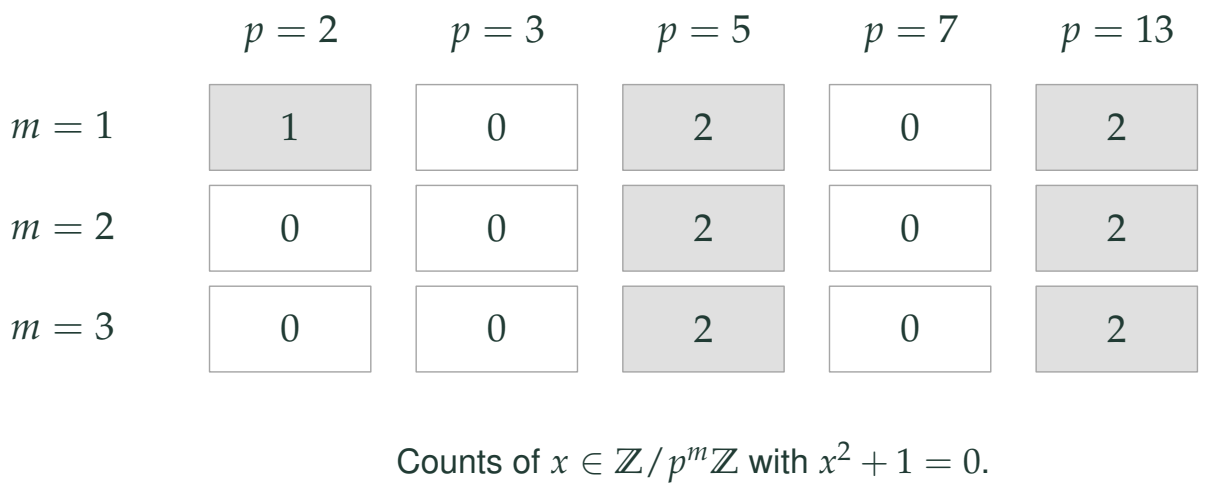
Reading the drawing
Columns select primes and rows select depths. At some primes the scalar equation has no residual root, at two its root dies at the next depth, and at five and thirteen simple roots continue. These are counts for a fixed scalar coefficient problem.
Drawing labels and data 24 labels
Read the original labels as selectable text. Tables preserve grid relationships; other short labels are grouped compactly.
| Row / column | \(p=2\) | \(p=3\) | \(p=5\) | \(p=7\) | \(p=13\) |
|---|---|---|---|---|---|
| \(m=1\) | \(1\) | \(0\) | \(2\) | \(0\) | \(2\) |
| \(m=2\) | \(0\) | \(0\) | \(2\) | \(0\) | \(2\) |
| \(m=3\) | \(0\) | \(0\) | \(2\) | \(0\) | \(2\) |
Counts of \(x\in\mathbb Z/p^m\mathbb Z\) with \(x^2+1=0\).
Where failure occurs matters
At \(p=3\) and \(p=7\), no residual root exists. At \(p=2\), the residual root exists but dies immediately: every odd square is one modulo four. At \(p=5\) and \(p=13\), the two residual roots are simple, and the usual one-digit equation gives one child above each root at every depth.
At five, one branch begins \(2,7,57,182\); the other is its negative modulo each power of five. Arbitrarily many digits in either branch cannot supply the absent scalar root over \({\mathbb Z}_3\). Nor can one root modulo two satisfy the hypothesis that every finite level is nonempty.
The paper's system-completion theorem uses a supplied common algebraic spine, finite nonempty levels at every coefficient place, coherent reductions, and closed local conditions. The scalar example isolates why these are substantive requirements. It is not a disproof of a companion theorem whose coefficients may be enlarged or whose objects are higher-dimensional representations.
Read this as
A residual root, roots at all depths, and roots at every required coefficient place are three distinct tests.