
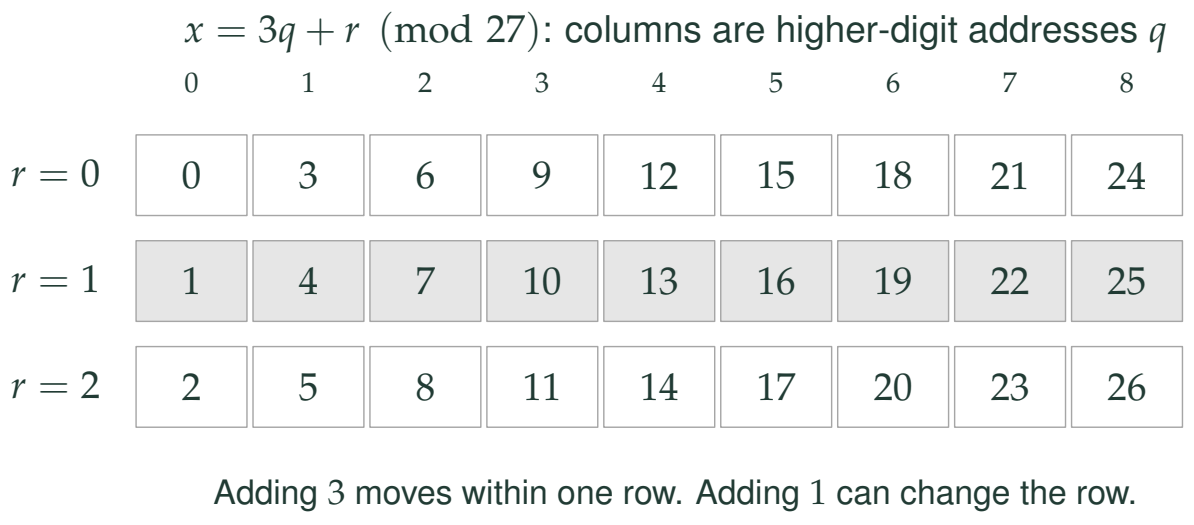
Work in \({\mathbb Z}/27{\mathbb Z}\). Every element has a unique form \(x=3q+r\) with \(r\in\{0,1,2\}\) and \(q\in\{0,\ldots,8\}\). The row below is the residual root. The column contains all the remaining information at this precision.
Reading the drawing
Rows are residual classes zero, one and two. Columns hold the higher-digit address. Adding three moves within a row; adding one can change the residual class. The highlighted row lists the addresses reducing to one.
Drawing labels and data 41 labels
Read the original labels as selectable text. Tables preserve grid relationships; other short labels are grouped compactly.
| Row / column | \(0\) | \(1\) | \(2\) | \(3\) | \(4\) | \(5\) | \(6\) | \(7\) | \(8\) |
|---|---|---|---|---|---|---|---|---|---|
| \(r=0\) | \(0\) | \(3\) | \(6\) | \(9\) | \(12\) | \(15\) | \(18\) | \(21\) | \(24\) |
| \(r=1\) | \(1\) | \(4\) | \(7\) | \(10\) | \(13\) | \(16\) | \(19\) | \(22\) | \(25\) |
| \(r=2\) | \(2\) | \(5\) | \(8\) | \(11\) | \(14\) | \(17\) | \(20\) | \(23\) | \(26\) |
\(x=3q+r\pmod{27}\): columns are higher-digit addresses \(q\)
Adding \(3\) moves within one row. Adding \(1\) can change the row.
Read the operation, not just the arrow
An operation \(x\mapsto x+3h\) preserves \(r\), because its correction vanishes modulo three. Repeated corrections of this form can visit every column in a row, but can never enter another row. By contrast, adding one changes the residual class. It is therefore not a positive-depth perturbation in this model.
For example, the addresses \(1,4,7,10,\ldots,25\) may be deeply connected by higher-digit changes. They remain disjoint from the addresses reducing to zero. In a genuine deformation problem, the same conclusion applies to operations whose reduction is the identity, not to every operation that happens to be called a deformation.
Read this as
Vertical completeness can fill one entire residual fiber without reaching a single point in a different fiber.
Evidence note from the source edition
All 27 addresses and their finite corrections are checked by integer reduction. Passing to an infinite perturbation stream additionally requires the convergence condition recorded in the formal no-crossing statement.