
Extend the function \(f(a,b)=\chi(a^2-2b^2\bmod5)\) periodically to \({\mathbb Z}^2\). Every complete \(5\times5\) residue tile has sum zero by the finite-field calculation. Only incomplete tiles can contribute to a box sum.
Reading the drawing
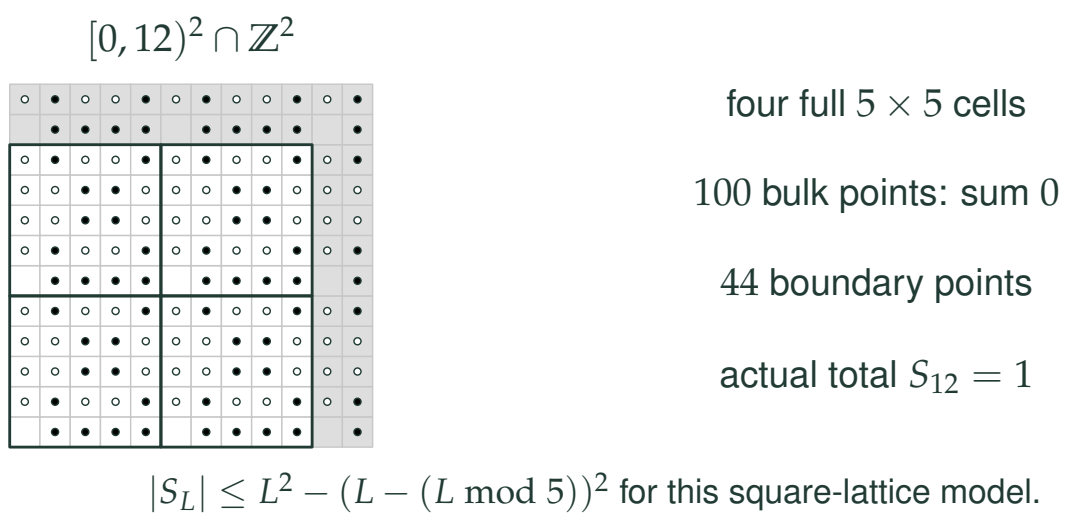
Four complete five-by-five tiles fill a ten-by-ten square inside the displayed twelve-by-twelve box. The complete tiles cancel. The remaining 44 points lie in the boundary strips. The exact residual sum and the geometric bound are separate pieces of information.
Drawing labels and data 6 labels
Read the original labels as selectable text. Tables preserve grid relationships; other short labels are grouped compactly.
\([0,12)^2\cap\mathbb Z^2\)
- four full \(5\times5\) cells
- \(100\) bulk points: sum \(0\)
- \(44\) boundary points
- actual total \(S_{12}=1\)
\(|S_L|\le L^2-(L-(L\bmod5))^2\) for this square-lattice model.
Separate bulk cancellation from boundary size
For \(0\le a,b<12\), four complete tiles fill a \(10\times10\) square and contribute zero. The remaining 44 points lie in the two boundary strips. Their exact sum is one. Since \(|f|\le1\), a bound of 44 follows without needing that final cancellation.
For a general positive integer \(L\), write \(L=5q+r\), \(0\le r<5\). The complete tiled square has side \(L-r\), so
The area is \(X=L^2\), making this a square-root-in-area bound for this square-box model. The proof is the exact tile decomposition; checking many \(L\) values is only a regression check of the implementation.
Number-field ideal sums involve different regions, lattice indices, signs, and generator multiplicities. Their \(X^{1-1/d}\) exponent cannot be justified simply by relabeling this square picture as an ideal-norm ball.
Read this as
A zero finite mean removes the bulk. The remaining estimate depends on the actual geometry of the region and its boundary.