
In \({\mathbb Z}_3\), every term of the sequence \(x_k=3^k\) is nonzero. Yet \(x_k\to0\) in the three-adic topology. The property “nonzero” is not closed, so a limit of objects satisfying it can lose that property.
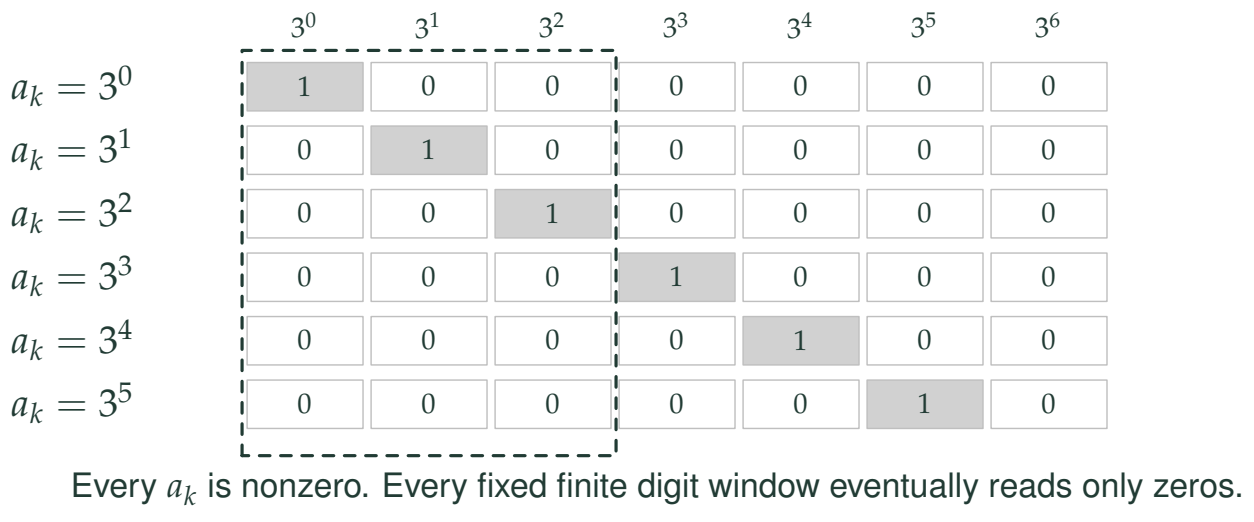
Reading the drawing
Rows are successive powers of three, each with one nonzero digit. That digit moves beyond any fixed finite window, illustrated by the dashed box. Every displayed integer is nonzero, but the sequence converges to zero. A target condition must be closed to pass through the inverse limit.
Drawing labels and data 56 labels
Read the original labels as selectable text. Tables preserve grid relationships; other short labels are grouped compactly.
| Row / column | \(3^{0}\) | \(3^{1}\) | \(3^{2}\) | \(3^{3}\) | \(3^{4}\) | \(3^{5}\) | \(3^{6}\) |
|---|---|---|---|---|---|---|---|
| \(a_k=3^{0}\) | \(1\) | \(0\) | \(0\) | \(0\) | \(0\) | \(0\) | \(0\) |
| \(a_k=3^{1}\) | \(0\) | \(1\) | \(0\) | \(0\) | \(0\) | \(0\) | \(0\) |
| \(a_k=3^{2}\) | \(0\) | \(0\) | \(1\) | \(0\) | \(0\) | \(0\) | \(0\) |
| \(a_k=3^{3}\) | \(0\) | \(0\) | \(0\) | \(1\) | \(0\) | \(0\) | \(0\) |
| \(a_k=3^{4}\) | \(0\) | \(0\) | \(0\) | \(0\) | \(1\) | \(0\) | \(0\) |
| \(a_k=3^{5}\) | \(0\) | \(0\) | \(0\) | \(0\) | \(0\) | \(1\) | \(0\) |
Every \(a_k\) is nonzero. Every fixed finite digit window eventually reads only zeros.
Polynomial conditions behave differently
For a continuous polynomial \(f\), if a convergent sequence satisfies \(f(x_k)=0\) for every \(k\), then continuity gives \(f(x)=0\) at its limit. More generally, a compatible residue branch satisfying \(f(x_m)\equiv0\pmod{3^m}\) reconstructs an exact root once the complete ring and its reduction maps have been identified.
The sequence \(3^k\) here is not presented as a compatible branch of nonzero residues modulo \(3^k\): those particular residues are zero. It is a convergent sequence of nonzero elements of the complete ring. The distinction prevents an incorrect finite-level interpretation of the picture.
In an arithmetic application, local conditions may be given by quotient equations, integral structures, or other data. The completion theorem requires a proof that the chosen condition is preserved by the limit under construction. The word “admissible” does not itself provide that proof.
Read this as
Compatibility reconstructs an object. Closedness is what carries the declared equations or conditions to that object.
Evidence note from the source edition
The finite diagram displays the retreat of the first nonzero digit. The convergence assertion follows from \(|3^k|_3=3^{-k}\), not from extrapolating a finite numerical plot.