
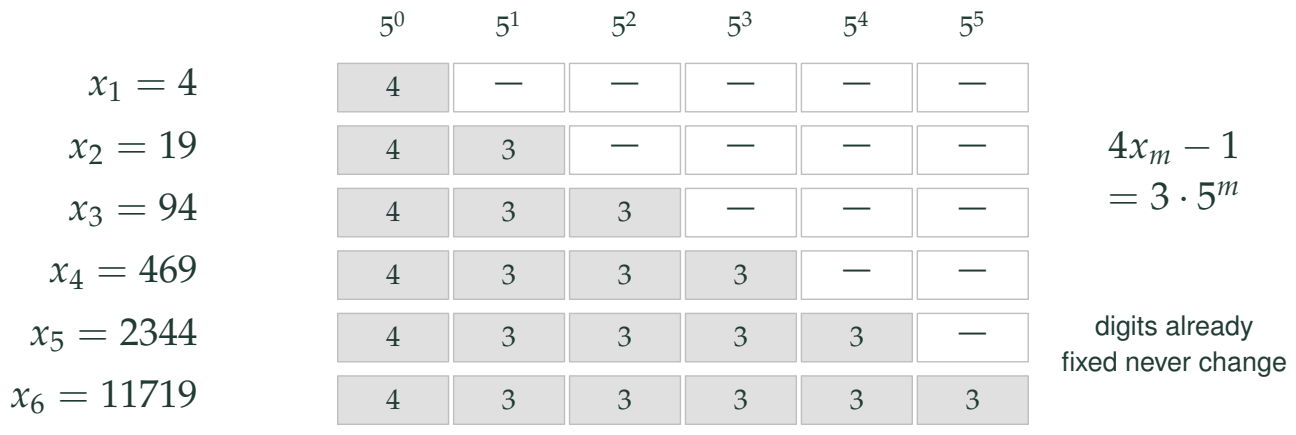
The rational number \(1/4\) is a five-adic integer. Its normalized residues are obtained by solving \(4x_m\equiv1\pmod{5^m}\), not by taking decimal approximations. At the first six depths they are \(4,19,94,469,2344,11719\).
Reading the drawing
Rows display successive representatives and columns display powers of five. Filled cells are fixed digits; unfilled cells are digits not yet retained at that depth. Dashes in the label table have the same meaning as unfilled cells in the drawing. Each new row appends a digit while keeping every earlier digit. The exact error formula is printed at the right.
Drawing labels and data 50 labels
Read the original labels as selectable text. Tables preserve grid relationships; other short labels are grouped compactly.
| Row / column | \(5^{0}\) | \(5^{1}\) | \(5^{2}\) | \(5^{3}\) | \(5^{4}\) | \(5^{5}\) |
|---|---|---|---|---|---|---|
| \(x_{1}=4\) | \(4\) | — | — | — | — | — |
| \(x_{2}=19\) | \(4\) | \(3\) | — | — | — | — |
| \(x_{3}=94\) | \(4\) | \(3\) | \(3\) | — | — | — |
| \(x_{4}=469\) | \(4\) | \(3\) | \(3\) | \(3\) | — | — |
| \(x_{5}=2344\) | \(4\) | \(3\) | \(3\) | \(3\) | \(3\) | — |
| \(x_{6}=11719\) | \(4\) | \(3\) | \(3\) | \(3\) | \(3\) | \(3\) |
\(4x_m-1\)
\(=3\cdot5^m\)
digits already
fixed never change
Compatibility is stronger than independent solvability
The residues satisfy both
The latter identity shows that the residual error tends to zero in the five-adic norm. The stabilized digit sequence is
This series is not convergent in the ordinary real norm. The topology is part of the statement. To view the branch as a positive-depth coordinate above the residual root \(4\), use \(t=x-4\in5{\mathbb Z}_5\).
An inverse-limit point is the entire compatible family, not its last displayed approximation. The six rows are a finite window; the displayed exact formula supplies a branch at every depth in this particular example. In the represented deformation theorem, compatibility reconstructs maps on all ring elements, with multiplication, continuity, and locality retained.
Read this as
A later approximation may append a digit. It may not revise a digit already certified by reduction.