
Let a six-dimensional rational carrier have the joint eigenvalue labels shown below for three commuting diagonal operators \(T_1,T_2,T_3\). Each coordinate is zero or one. Selecting a zero uses \(I-T_i\); selecting a one uses \(T_i\).
Reading the drawing
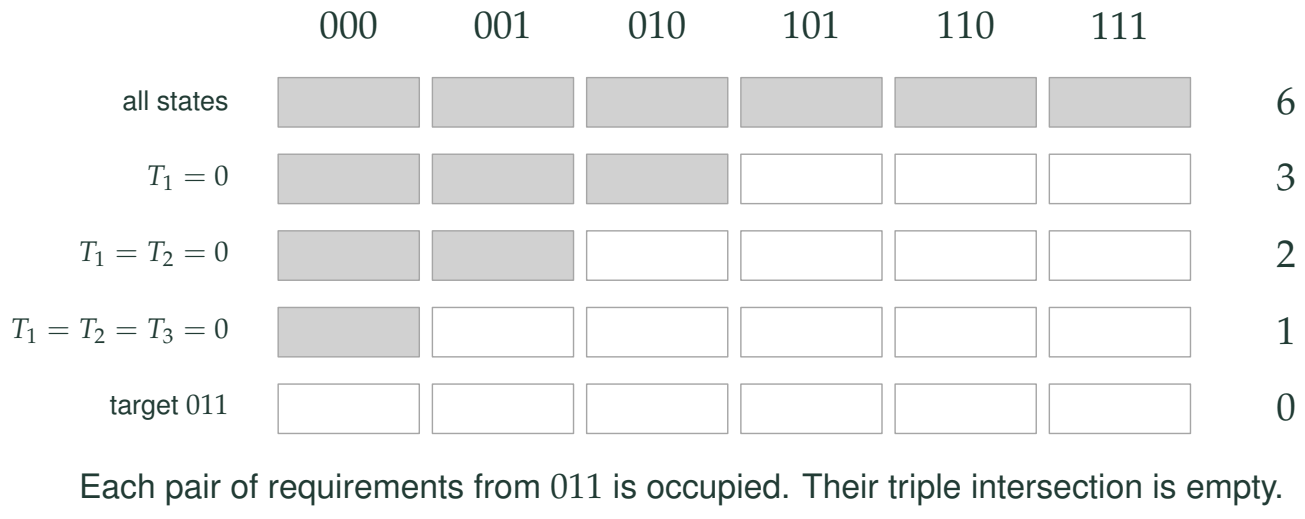
The occupancy table has six states as columns. Its rows compare successive zero-eigenvalue restrictions with the missing target 011. Each pair of the target requirements has an occupied state, while all three together have none. The example therefore keeps joint occupancy explicit.
Drawing labels and data 17 labels
Read the original labels as selectable text. Tables preserve grid relationships; other short labels are grouped compactly.
- \(000\)
- \(001\)
- \(010\)
- \(101\)
- \(110\)
- \(111\)
- all states
- \(6\)
- \(T_1=0\)
- \(3\)
- \(T_1=T_2=0\)
- \(2\)
- \(T_1=T_2=T_3=0\)
- \(1\)
- target \(011\)
- \(0\)
Each pair of requirements from \(011\) is occupied. Their triple intersection is empty.
The full conjunction is a different test
For target \((0,0,0)\), successive conditions reduce the ranks from \(6\) to \(3\), then \(2\), then \(1\). The joint projector is nonzero, so that label is occupied in this carrier.
For target \((0,1,1)\), every pair of conditions is occupied: \((0,1,0)\) witnesses the first two, \((0,0,1)\) the first and third, and \((1,1,1)\) the second and third. But the triple itself is absent. Multiplying all three selectors gives the zero matrix.
The checks compute all eight joint projectors, their pairwise orthogonality, and their sum. The sum is the identity even though two labels are absent: those two projectors are simply zero.
Read this as
A formula for a projector does not force its image to be nonzero. Occupancy must be tested on the complete set of required conditions.