
A scalar \(a\in{\mathbb F}_5^\times\) acts on a degree-\(d\) algebra with determinant \(a^d\). Therefore the scalar cancellation route tests \(\chi(a^d)\), not merely \(\chi(a)\).
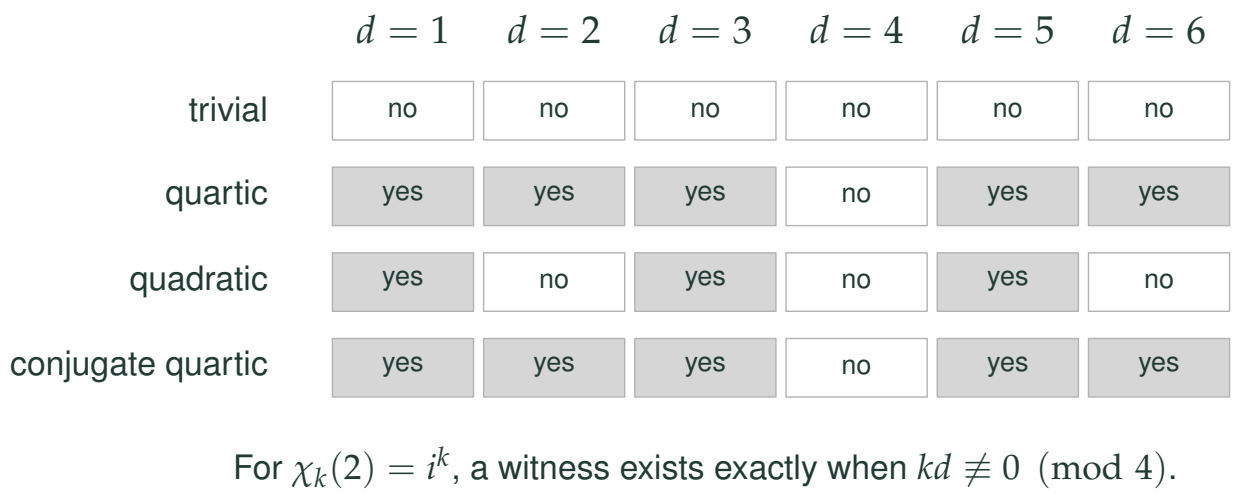
Reading the drawing
The displayed finite values distinguish nontriviality of a character from the stronger condition needed after restricting to scalar powers. The source states the exact exceptional case and retains the separate nonscalar witness.
Drawing labels and data 35 labels
Read the original labels as selectable text. Tables preserve grid relationships; other short labels are grouped compactly.
- \(d=1\)
- \(d=2\)
- \(d=3\)
- \(d=4\)
- \(d=5\)
- \(d=6\)
- trivial
- no
- no
- no
- no
- no
- no
- quartic
- yes
- yes
- yes
- no
- yes
- yes
- quadratic
- yes
- no
- yes
- no
- yes
- no
- conjugate quartic
- yes
- yes
- yes
- no
- yes
- yes
For \(\chi_k(2)=i^k\), a witness exists exactly when \(kd\not\equiv0\pmod4\).
A failed sufficient test is not an impossibility theorem
Let \(\chi_4(2)=i\) generate the character group of \({\mathbb F}_5^\times\), and write \(\chi_k=\chi_4^k\). Since \(2\) generates the unit group,
For the quadratic character \(k=2\) and degree \(d=2\), every scalar test is trivial. Yet page Visual 23 supplies the nonscalar witness \(2u\), proving cancellation in that specific algebra. Scalar exceptional does not mean exceptional for every possible quotient unit.
Conversely, the quartic character \(k=1\) works in degree two even though \(\gcd(2,4)\ne1\). Thus the simpler degree–totient coprimality criterion is sufficient, not necessary. With degree three, every nontrivial character passes because exponentiation by three permutes the units.
The retained scalar/Mellin continuation states its public hypothesis in the weaker exact scalar-power form. It does not claim to construct a nonscalar witness for every scalar-exceptional arithmetic character.
Read this as
Test the character after the degree-power map. Nontriviality before that map can disappear after it.