
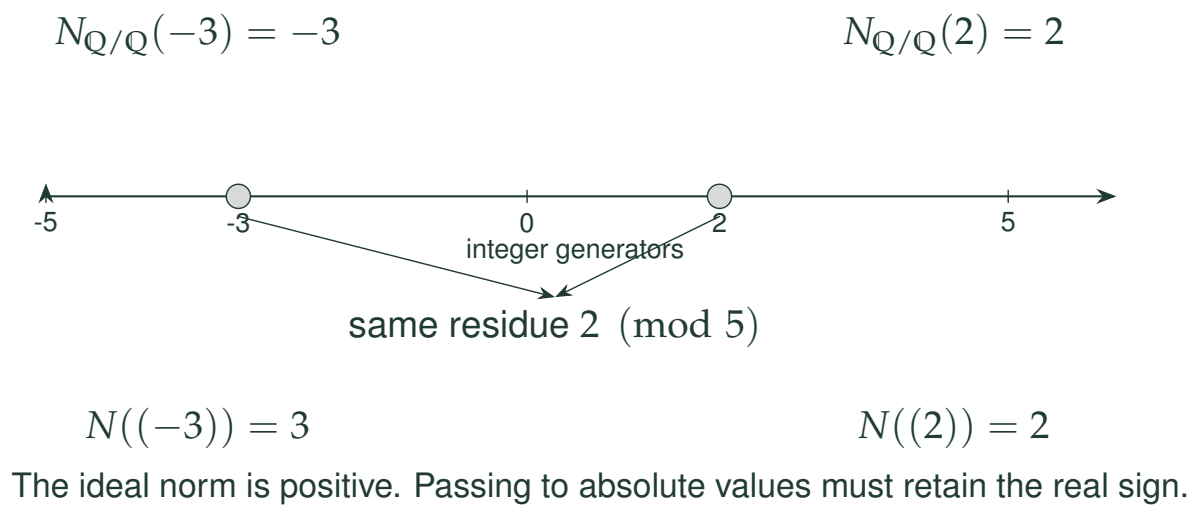
Even in the number field \({\mathbb Q}\), congruent generators need not have congruent absolute norms. The integers \(2\) and \(-3\) are congruent modulo five. Their signed field norms are congruent, but their absolute values are not.
Reading the drawing
The exact examples retain both the sign of the element norm and the corresponding ideal data. Replacing one by the other would discard arithmetic information used by the character model.
Drawing labels and data 12 labels
Read the original labels as selectable text. Tables preserve grid relationships; other short labels are grouped compactly.
- -5
- -3
- 0
- 2
- 5
- integer generators
- same residue \(2\pmod5\)
\(N_{\mathbb Q/\mathbb Q}(-3)=-3\)
\(N_{\mathbb Q/\mathbb Q}(2)=2\)
- \(N((-3))=3\)
- \(N((2))=2\)
The ideal norm is positive. Passing to absolute values must retain the real sign.
The smallest counterexample is already decisive
For \(K={\mathbb Q}\),
whereas
Here \(N((a))\) is the positive index of the ideal \((a)\), equal to \(|a|\). The determinant norm of an element is signed. Taking absolute values is not a ring operation and does not commute with reduction in this example.
The retained scalar/Mellin continuation counts the two real norm signs separately before reassembling its generator-to-ideal sums. Its exact comparison also includes the roots-of-unity multiplicity and the norm of the chosen inverse-class representative. Omitting those factors would change the arithmetic sum, not merely its normalization.
The finite-field norm on the following pages is a determinant in a finite algebra. It has no ordering or absolute-value sign. Its role is to control residue characters before the separate real-lattice counting argument.
Read this as
Do not infer an ideal-norm residue from a generator congruence without accounting for the sign in the element-to-ideal comparison.