
Let \(X_m=\{n\in{\mathbb Z}:n\ge m\}\), with the inclusion \(X_{m+1}\hookrightarrow X_m\) as transition map. Every level is nonempty. Every vertex has at most one child. Yet there is no compatible infinite branch.
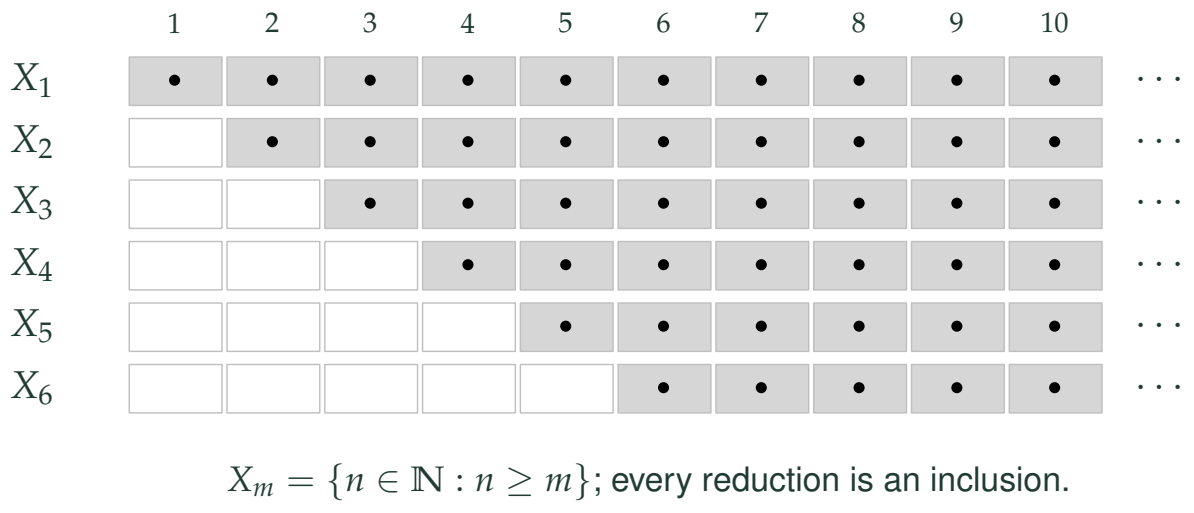
Reading the drawing
Each column selects a fixed integer and each row a level. A column ends when that integer no longer belongs to the level. Every displayed level has further columns, but no fixed column survives every level. The omitted finiteness hypothesis is essential to the compactness argument.
Drawing labels and data 23 labels
Read the original labels as selectable text. Tables preserve grid relationships; other short labels are grouped compactly.
- \(1\)
- \(2\)
- \(3\)
- \(4\)
- \(5\)
- \(6\)
- \(7\)
- \(8\)
- \(9\)
- \(10\)
- \(X_1\)
- \(\cdots\)
- \(X_2\)
- \(\cdots\)
- \(X_3\)
- \(\cdots\)
- \(X_4\)
- \(\cdots\)
- \(X_5\)
- \(\cdots\)
- \(X_6\)
- \(\cdots\)
\(X_m=\{n\in\mathbb N:n\ge m\}\); every reduction is an inclusion.
The missing hypothesis is not surjectivity
Compatibility would force all coordinates of a branch to be one fixed integer \(n\). Membership at every level would then require \(n\ge m\) for every \(m\), which is impossible. Each vertical column in the drawing eventually ends. A finite window always contains columns extending beyond it, but no single column survives all windows.
There is no contradiction with finite-branch compactness: these levels are infinite. Attaching a common artificial root would give that root infinitely many children. The finitely branching rooted-tree argument therefore does not apply.
In the paper, finite nonempty levels and actual total reduction maps provide compactness even when some vertices die and some transition maps are not onto. One can retain only vertices with descendants at arbitrarily large depths. Finiteness makes that surviving part nonempty and permits compatible choices.
Read this as
Arbitrarily long finite paths are not automatically one infinite path. The finite-level hypothesis prevents escape to new roots.