
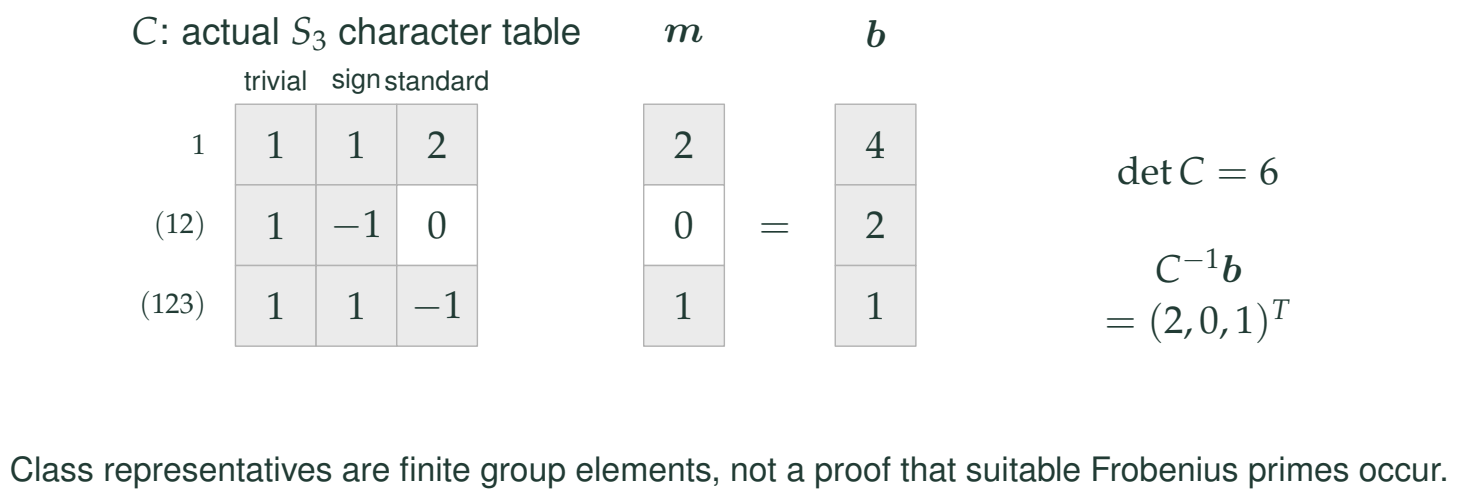
Use the three irreducible characters of \(S_3\): trivial, sign, and standard. On the identity, a transposition, and a three-cycle, their values form the matrix below. Rows are samples; columns are constituent types.
Reading the drawing
The rows are selected conjugacy classes and the columns are constituent characters. Their trace vectors separate the displayed types by finite linear algebra. Using this matrix arithmetically also requires actual primes with the specified Frobenius witnesses.
Drawing labels and data 28 labels
Read the original labels as selectable text. Tables preserve grid relationships; other short labels are grouped compactly.
- \(C\): actual \(S_3\) character table
| Row / column | trivial | sign | standard |
|---|---|---|---|
| \(1\) | \(1\) | \(1\) | \(2\) |
| \((12)\) | \(1\) | \(-1\) | \(0\) |
| \((123)\) | \(1\) | \(1\) | \(-1\) |
- \(\boldsymbol m\)
- \(2\)
- \(0\)
- \(1\)
- \(=\)
- \(\boldsymbol b\)
- \(4\)
- \(2\)
- \(1\)
- \(\det C=6\)
\(C^{-1}\boldsymbol b\)
\(=(2,0,1)^T\)
Class representatives are finite group elements, not a proof that suitable Frobenius primes occur.
What full rank buys
Since \(\det C=6\), these samples distinguish every rational multiplicity vector. A target with two trivial constituents, no sign constituent, and one standard constituent has
Solving \(C\boldsymbol m=\boldsymbol b\) recovers the unique rational vector. The standard character is not introduced as an arbitrary list: the checks construct matrices for a transposition and a three-cycle, verify their group relations, and obtain their traces.
This finite example explains the linear algebra after separating samples are available. For the arithmetic theorem, the samples must be genuine unramified Frobenius classes with the required compatibility and allowed-prime conditions. Selecting abstract group elements does not construct such primes.
The scalar/Mellin checkpoint supplies a separator assembly conditional on arithmetic coverage. The later checked source Claim91ConstructedClosure discharges that interface for its rational-base contract. Neither result follows from the finite character table displayed here.
Read this as
Invertibility answers reconstruction from these samples. Arithmetic occurrence answers whether the required samples can be taken at actual primes.