
A common spine records algebraic data before reducing at a coefficient prime. For a small model, take the one polynomial
Its reductions at five and seven look different, but they come from the same coefficients.
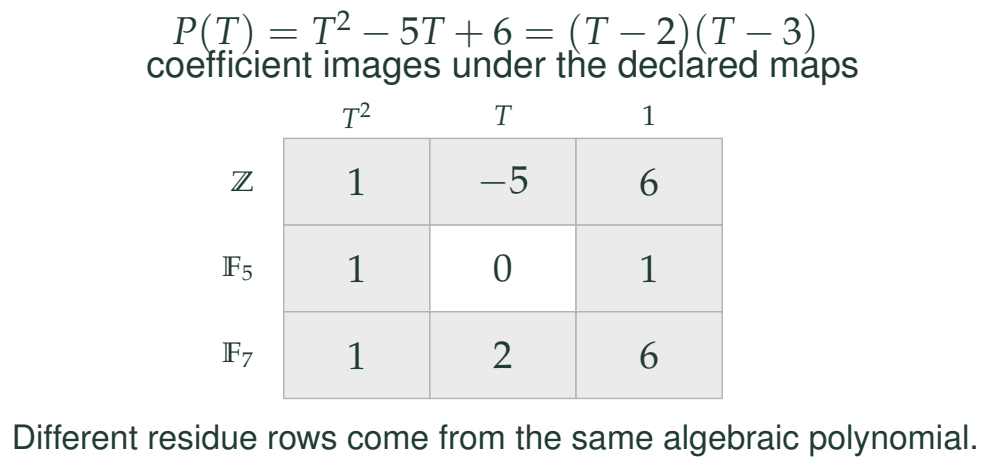
Reading the drawing
The same integral polynomial is reduced at two primes. The integer coefficient row and its reductions modulo five and seven differ while coming from that common polynomial. This records data to be realized; the diagram alone does not construct a member at every place.
Drawing labels and data 18 labels
Read the original labels as selectable text. Tables preserve grid relationships; other short labels are grouped compactly.
- \(P(T)=T^2-5T+6=(T-2)(T-3)\)
- coefficient images under the declared maps
| Row / column | \(T^2\) | \(T\) | \(1\) |
|---|---|---|---|
| \(\mathbb Z\) | \(1\) | \(-5\) | \(6\) |
| \(\mathbb F_5\) | \(1\) | \(0\) | \(1\) |
| \(\mathbb F_7\) | \(1\) | \(2\) | \(6\) |
Different residue rows come from the same algebraic polynomial.
Agreement means descent from supplied data
Modulo five the polynomial is \(T^2+1\); modulo seven it is \(T^2+2T+6\). The roots \(2\) and \(3\) are the reductions of the same integer roots in both places. The coefficient lists are not required to be equal as raw residues in different rings.
The paper's common spine is larger: it includes characteristic polynomials at the permitted arithmetic places and the specified determinant, weight, and local labels. Requiring every finite member to match those reductions is a compatibility condition on existing objects. It is not a construction of the objects.
Finite agreement also leaves ambiguity. Adding \(35\) to an integer coefficient changes neither its residue modulo five nor its residue modulo seven. Thus two finite coefficient observations do not determine a unique global polynomial without a height bound or further exact information. Conversely, one arbitrarily chosen family of local objects need not descend to an algebraic spine.
Read this as
The common spine is input shared across coefficient places. It is not created by comparing unrelated residue labels after the fact.