
A representative needed by an arithmetic argument often has to avoid a prescribed finite collection of primes. A small integer version asks for
There is exactly one solution modulo 30: \(x=29\).
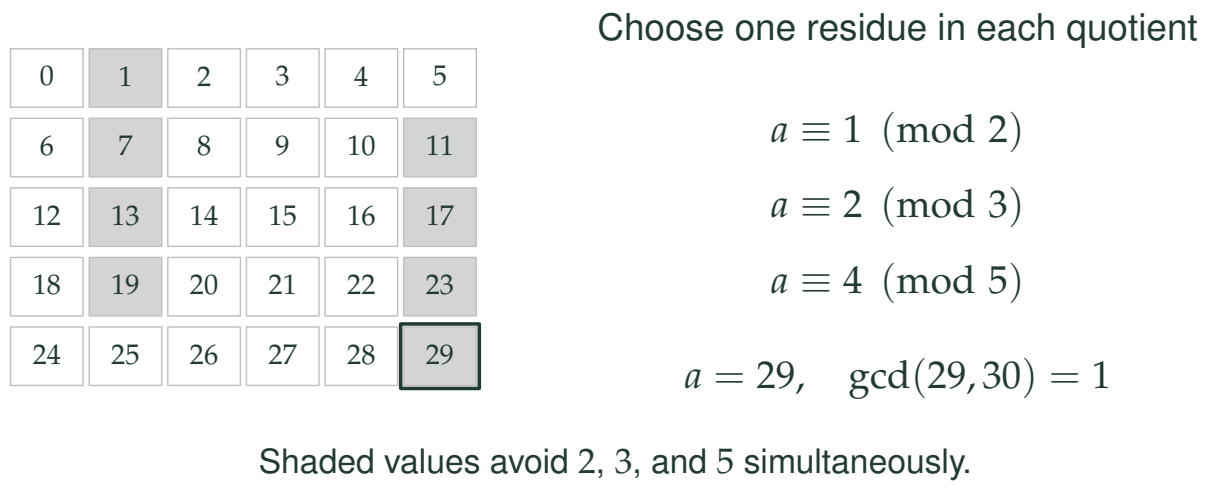
Reading the drawing
The congruence classes and representatives show how to satisfy the supplied modulus conditions while avoiding a declared finite set of primes. Each constraint belongs to this explicit finite model.
Drawing labels and data 36 labels
Read the original labels as selectable text. Tables preserve grid relationships; other short labels are grouped compactly.
| Row / column | Column 1 | Column 2 | Column 3 | Column 4 | Column 5 | Column 6 |
|---|---|---|---|---|---|---|
| Row 1 | \(0\) | \(1\) | \(2\) | \(3\) | \(4\) | \(5\) |
| Row 2 | \(6\) | \(7\) | \(8\) | \(9\) | \(10\) | \(11\) |
| Row 3 | \(12\) | \(13\) | \(14\) | \(15\) | \(16\) | \(17\) |
| Row 4 | \(18\) | \(19\) | \(20\) | \(21\) | \(22\) | \(23\) |
| Row 5 | \(24\) | \(25\) | \(26\) | \(27\) | \(28\) | \(29\) |
- Choose one residue in each quotient
- \(a\equiv1\pmod2\)
- \(a\equiv2\pmod3\)
- \(a\equiv4\pmod5\)
- \(a=29,\quad\gcd(29,30)=1\)
Shaded values avoid \(2\), \(3\), and \(5\) simultaneously.
Avoidance and ideal class are different constraints
The selected residues are nonzero modulo each forbidden prime, so \(\gcd(29,30)=1\). The eight units modulo 30 are displayed separately. They all avoid the primes, but only one also satisfies the three specific residue prescriptions.
The continuation proves an ideal-theoretic analogue with more structure: in every prescribed inverse ideal class it constructs a nonzero integral representative whose norm is coprime to the nonzero modulus. That removes a representative-choice assumption from the public norm-character bound. It does not remove the remaining character, lattice, or Frobenius-occurrence obligations.
The integer CRT calculation is an illustration, not a proof of the ideal-class representative theorem. In particular, enumerating integers cannot impose a nontrivial ideal class. The full construction uses prime-ideal avoidance and its source comparison to the class group.
Read this as
A finite avoidance argument supplies an admissible representative. It does not by itself make the arithmetic object being counted, or the desired Frobenius class, occur.
Evidence note from the source edition
All 30 residue classes are tested exactly. The unique CRT result and the unit count are independent finite outputs of the check script.