
Now impose \(x^2=0\) modulo \(3^m\). The condition is exactly \(2v_3(x)\ge m\), so the roots are the multiples of \(3^{\lceil m/2\rceil}\) in that quotient. Their number is \(3^{m-\lceil m/2\rceil}\).
Reading the drawing
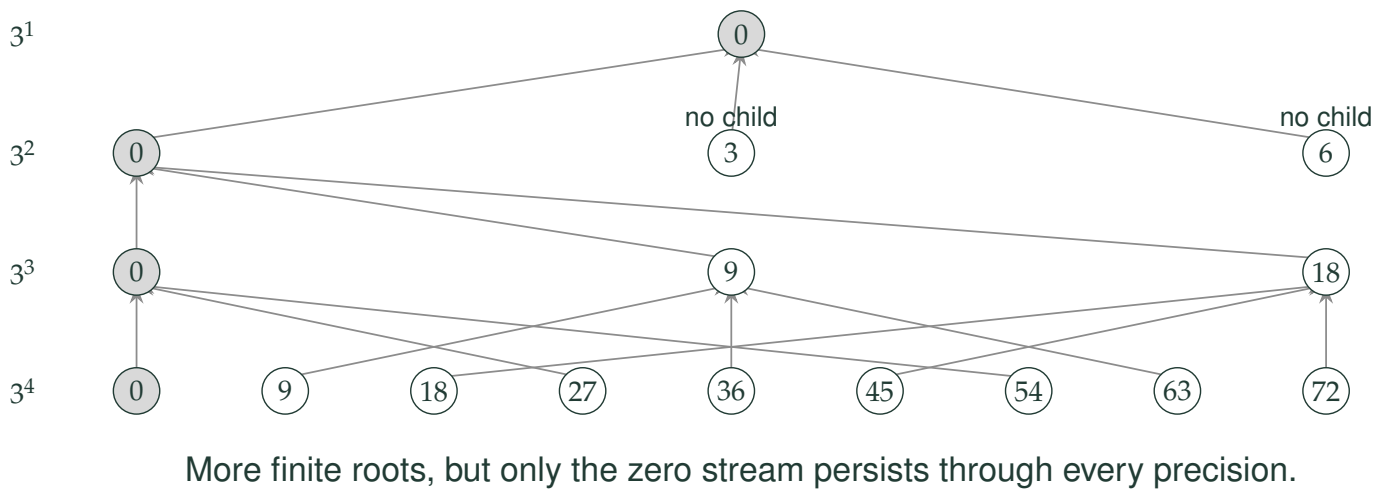
Vertices are roots at successive powers of three, and arrows reduce a root to its parent. Some finite roots have no child. The zero column persists; growth of the number of finite roots does not create additional infinite branches in this model.
Drawing labels and data 23 labels
Read the original labels as selectable text. Tables preserve grid relationships; other short labels are grouped compactly.
- \(0\)
- \(0\)
- \(3\)
- \(6\)
- \(0\)
- \(9\)
- \(18\)
- \(0\)
- \(9\)
- \(18\)
- \(27\)
- \(36\)
- \(45\)
- \(54\)
- \(63\)
- \(72\)
- \(3^{1}\)
- \(3^{2}\)
- \(3^{3}\)
- \(3^{4}\)
- no child
- no child
More finite roots, but only the zero stream persists through every precision.
Count vertices and count branches separately
There are three roots modulo nine: \(0,3,6\). But the only roots modulo \(27\) are \(0,9,18\), and all three reduce to zero modulo nine. The other two vertices at the previous level have no children. Counting them as permanent branches would be incorrect.
The count-growth exponent is \(\lim_m\log_3(\#X_m)/m=1/2\). Nevertheless, a compatible branch reconstructs \(x\in{\mathbb Z}_3\) with \(x^2=0\). Since \({\mathbb Z}_3\) has no nonzero nilpotent, the only such branch is the zero branch.
More generally, \(x^e=0\) has count \(q^{m-\lceil m/e\rceil}\) and count-growth exponent \(1-1/e\). These exponents describe finite thickenings. They do not assert that the set of complete roots has a fractional geometric dimension or more than one point.
Read this as
The seed zeta function counts finite-level solutions. It is not a generating function for distinct infinite branches.