
Retain the previous complex. The valid A-packet projectors are \(P^0={\operatorname{diag}}(1,0)\), \(P^1={\operatorname{diag}}(1,1,0,0)\), and \(P^2={\operatorname{diag}}(1,0)\). They satisfy \(d_rP^r=P^{r+1}d_r\).
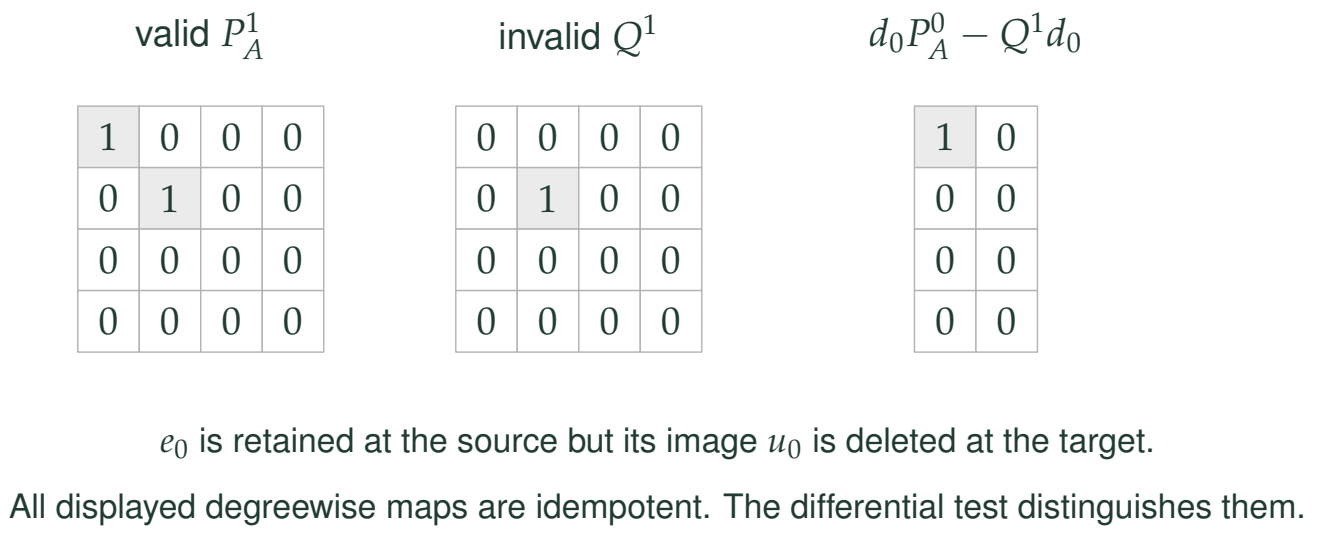
Reading the drawing
The matrices compare degreewise cuts with the differential. The valid packet commutes with the maps. The alternative cut has a nonzero defect, so its selected subspaces do not define the claimed cohomology summand.
Drawing labels and data 45 labels
Read the original labels as selectable text. Tables preserve grid relationships; other short labels are grouped compactly.
- valid \(P_A^1\)
| Row / column | Column 1 | Column 2 | Column 3 | Column 4 |
|---|---|---|---|---|
| Row 1 | \(1\) | \(0\) | \(0\) | \(0\) |
| Row 2 | \(0\) | \(1\) | \(0\) | \(0\) |
| Row 3 | \(0\) | \(0\) | \(0\) | \(0\) |
| Row 4 | \(0\) | \(0\) | \(0\) | \(0\) |
- invalid \(Q^1\)
| Row / column | Column 1 | Column 2 | Column 3 | Column 4 |
|---|---|---|---|---|
| Row 1 | \(0\) | \(0\) | \(0\) | \(0\) |
| Row 2 | \(0\) | \(1\) | \(0\) | \(0\) |
| Row 3 | \(0\) | \(0\) | \(0\) | \(0\) |
| Row 4 | \(0\) | \(0\) | \(0\) | \(0\) |
- \(d_0P_A^0-Q^1d_0\)
| Row / column | Column 1 | Column 2 |
|---|---|---|
| Row 1 | \(1\) | \(0\) |
| Row 2 | \(0\) | \(0\) |
| Row 3 | \(0\) | \(0\) |
| Row 4 | \(0\) | \(0\) |
\(e_0\) is retained at the source but its image \(u_0\) is deleted at the target.
All displayed degreewise maps are idempotent. The differential test distinguishes them.
A boundary can cross an incompatible cut
Replace the degree-one projector by \(Q^1={\operatorname{diag}}(0,1,0,0)\) while keeping \(P^0\). Then
The selected degree-zero component is sent outside the selected degree-one component. There is no subcomplex with these cuts, so the cohomology packet theorem cannot be applied to them. Both matrices remain perfectly valid idempotents; the failure is compatibility with the differential.
This example separates two kinds of obstruction. The nonzero matrix above obstructs this proposed decomposition. A nonzero class in \(H^2\) may obstruct a lift only after the deformation problem and its obstruction map have been identified. One should not equate every failed projector commutator with an arithmetic obstruction class.
The exact checks verify both commuting diagrams for the valid family and reject the altered family. They also enumerate the finite kernels and images, so the dimension comparison is not inferred from the drawing.
Read this as
A projector on each vector space is not yet a projector on the complex. The differential must respect the chosen packets.