
Let \(\chi\) be the quadratic character modulo five, extended by \(\chi(0)=0\). In the field on the preceding page, choose \(v=2u\). Its norm is \(N(v)=2\), so \(\chi(N(v))=-1\).
Reading the drawing
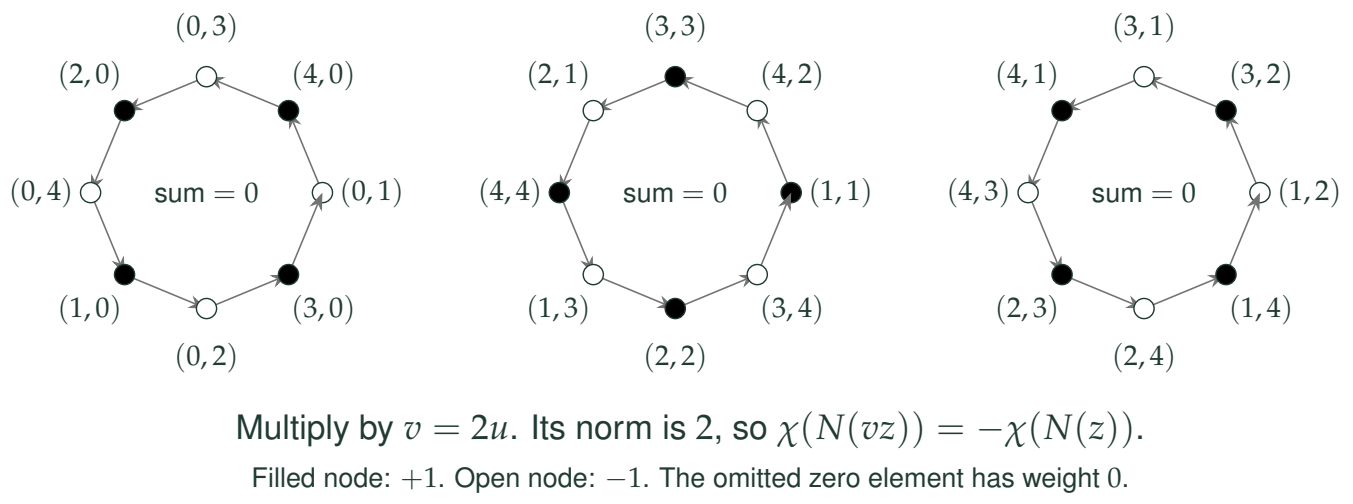
Multiplication by the displayed unit cycles through each eight-element orbit. Filled and open vertices have weights plus and minus one. Each orbit sums to zero; the omitted zero element has weight zero. This is the supplied finite-field permutation argument.
Drawing labels and data 29 labels
Read the original labels as selectable text. Tables preserve grid relationships; other short labels are grouped compactly.
- \((0,1)\)
- \((4,0)\)
- \((0,3)\)
- \((2,0)\)
- \((0,4)\)
- \((1,0)\)
- \((0,2)\)
- \((3,0)\)
- sum \(=0\)
- \((1,1)\)
- \((4,2)\)
- \((3,3)\)
- \((2,1)\)
- \((4,4)\)
- \((1,3)\)
- \((2,2)\)
- \((3,4)\)
- sum \(=0\)
- \((1,2)\)
- \((3,2)\)
- \((3,1)\)
- \((4,1)\)
- \((4,3)\)
- \((2,3)\)
- \((2,4)\)
- \((1,4)\)
- sum \(=0\)
Multiply by \(v=2u\). Its norm is \(2\), so \(\chi(N(vz))=-\chi(N(z))\).
Filled node: \(+1\). Open node: \(-1\). The omitted zero element has weight \(0\).
The whole sum is paired with its negative
Multiplication by \(v\) permutes the 25 elements. Norm multiplicativity gives
The sum is an integer, so it is zero. The origin contributes zero. The other 24 elements fall into three cycles of length eight under multiplication by \(v\); the character signs alternate around each cycle.
The same reasoning works with a complex root of unity \(\chi(N(v))\ne1\): subtracting the two equal sums gives \((1-\chi(N(v)))S=0\). The essential inputs are an actual permutation, a multiplicative norm, and a nontrivial character value. They are not consequences of drawing an alternating cycle.
In the arithmetic continuation the quotient is the actual additive module \(J/mJ\) associated with an ideal representative. This finite-field example isolates the cancellation mechanism while keeping that broader module and lattice comparison separate.
Read this as
The witness is one unit that changes the character value. Once it exists, the permutation cancels the entire finite mean.