
The character matrix has determinant six, so its inverse contains a factor of two in the denominator. That arithmetic fact is visible as a loss of one binary digit in trace reconstruction.
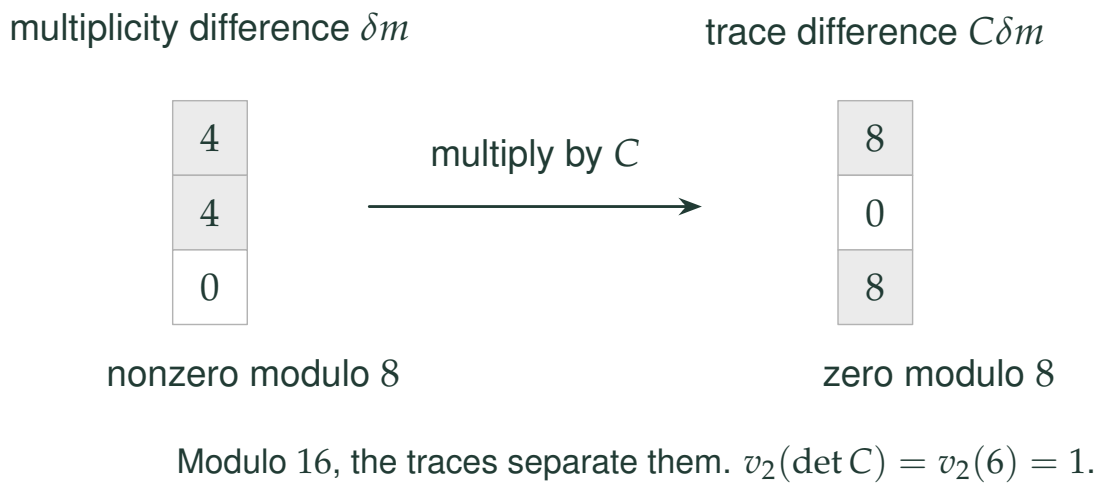
Reading the drawing
A multiplicity-difference vector maps through the supplied trace matrix to a trace-difference vector. The first vector is nonzero modulo eight while the second is zero modulo eight. Modulo sixteen the traces separate them. The determinant has dyadic valuation one, recording the exact digit loss.
Drawing labels and data 12 labels
Read the original labels as selectable text. Tables preserve grid relationships; other short labels are grouped compactly.
- multiplicity difference \(\delta m\)
- \(4\)
- \(4\)
- \(0\)
- trace difference \(C\delta m\)
- \(8\)
- \(0\)
- \(8\)
- multiply by \(C\)
- nonzero modulo \(8\)
- zero modulo \(8\)
Modulo \(16\), the traces separate them. \(v_2(\det C)=v_2(6)=1\).
A concrete ambiguity modulo eight
The multiplicity difference \(\delta\boldsymbol m=(4,4,0)\) is nonzero modulo eight, but
Thus traces known modulo eight do not distinguish those two residue vectors. The same trace difference is nonzero modulo sixteen, so one more trace digit resolves this ambiguity.
More generally, the kernel of \(C\) modulo \(2^n\) has exactly two elements:
To see this, the second equation gives \(m_1=m_2\); the third gives \(m_3=2m_1\); the first then gives \(6m_1=0\). Three is a unit modulo \(2^n\), leaving precisely the displayed possibilities.
Conversely, \(C\delta\boldsymbol m\equiv0\pmod{2^{n+1}}\) implies \(6\delta\boldsymbol m\equiv0\pmod{2^{n+1}}\) by the adjugate identity, hence \(\delta\boldsymbol m\equiv0\pmod{2^n}\). Capacity bounds can remove ambiguity earlier in a particular carrier, but do not change this universal linear precision calculation.
Read this as
Full rank over characteristic zero is not the same as invertibility over every residue ring. Denominator valuations determine the needed extra precision.