
For the two roots of \(x^2+1=0\) modulo powers of five, negation is an actual reversible transport. It preserves the equation, is its own inverse, and commutes with reduction.
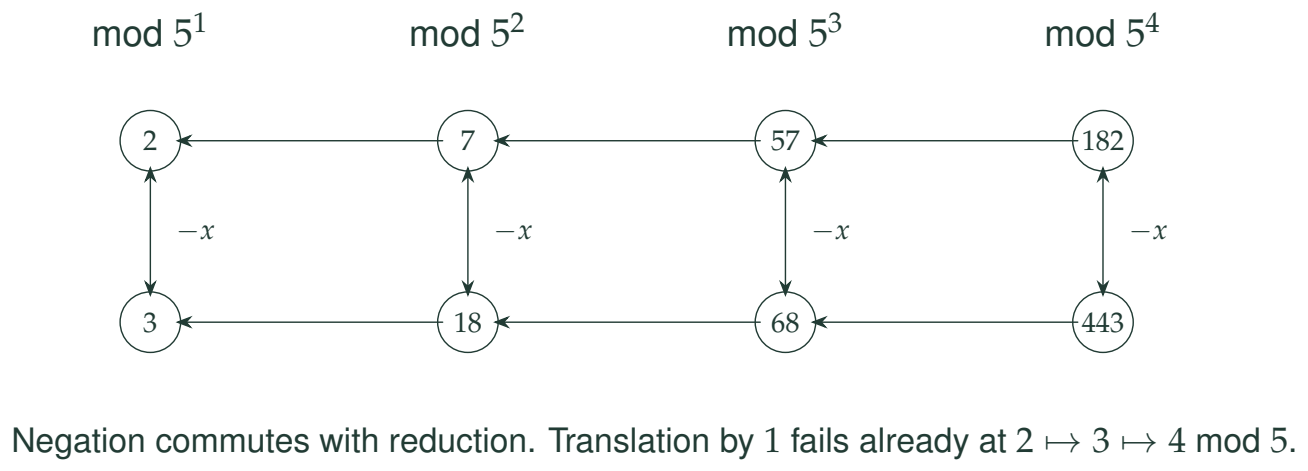
Reading the drawing
At each finite depth, arrows pair roots under negation. Vertical reductions agree with these pairings. The example checks one reversible operation on the declared scalar problem; it does not supply every proposed arithmetic transport.
Drawing labels and data 17 labels
Read the original labels as selectable text. Tables preserve grid relationships; other short labels are grouped compactly.
- mod \(5^{1}\)
- \(2\)
- \(3\)
- \(-x\)
- mod \(5^{2}\)
- \(7\)
- \(18\)
- \(-x\)
- mod \(5^{3}\)
- \(57\)
- \(68\)
- \(-x\)
- mod \(5^{4}\)
- \(182\)
- \(443\)
- \(-x\)
Negation commutes with reduction. Translation by \(1\) fails already at \(2\mapsto3\mapsto4\) mod \(5\).
One successful input is not a natural transformation
At every depth \(m\),
The two compatible branches beginning at \(2\) and \(3\) are exchanged. Because \(2\not\equiv3\pmod5\), this transport changes the residual root. It is horizontal rather than a positive-depth correction.
Translation by one is a useful false control. Modulo five it takes the root \(2\) to the root \(3\), but takes the root \(3\) to \(4\), which is not a root. A single successful arrow between selected points does not define an operation on the whole deformation problem.
Even negation is admissible only for the equation and conditions stated here. An extra condition that fixes the residual root at \(2\) would not be preserved. Likewise, a representation-theoretic dual or twist needs its own compatibility checks for the chosen local data and carrier.
Read this as
A transport is a family of maps respecting equations and reductions. A convenient pair of endpoints is not enough.
Evidence note from the source edition
Both branches are computed by exact one-digit lifting. Negation is checked on all roots at the displayed depths; its universal reduction identity follows directly from ring homomorphism laws.