
The finite occupancy theorem uses a split semisimple commuting family in characteristic zero. Two tiny matrices show why neither the coefficient condition nor semisimplicity should disappear from the statement.
Reading the drawing
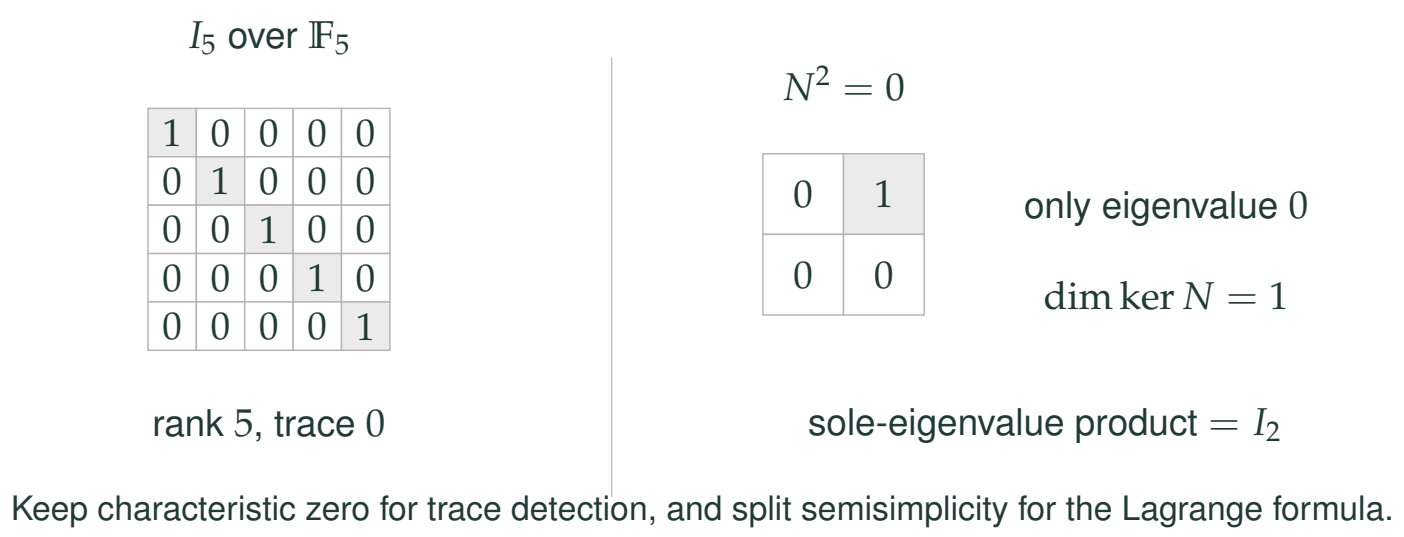
An identity matrix over the field with five elements has rank five but trace zero. A nonzero nilpotent two-by-two matrix has only eigenvalue zero, yet its kernel has dimension one. These controls explain why coefficient characteristic and split semisimplicity are explicit hypotheses.
Drawing labels and data 36 labels
Read the original labels as selectable text. Tables preserve grid relationships; other short labels are grouped compactly.
\(I_5\) over \(\mathbb F_5\)
| Row / column | Column 1 | Column 2 | Column 3 | Column 4 | Column 5 |
|---|---|---|---|---|---|
| Row 1 | \(1\) | \(0\) | \(0\) | \(0\) | \(0\) |
| Row 2 | \(0\) | \(1\) | \(0\) | \(0\) | \(0\) |
| Row 3 | \(0\) | \(0\) | \(1\) | \(0\) | \(0\) |
| Row 4 | \(0\) | \(0\) | \(0\) | \(1\) | \(0\) |
| Row 5 | \(0\) | \(0\) | \(0\) | \(0\) | \(1\) |
- rank \(5\), trace \(0\)
- \(N^2=0\)
| Row / column | Column 1 | Column 2 |
|---|---|---|
| Row 1 | \(0\) | \(1\) |
| Row 2 | \(0\) | \(0\) |
- only eigenvalue \(0\)
- \(\dim\ker N=1\)
- sole-eigenvalue product \(=I_2\)
Keep characteristic zero for trace detection, and split semisimplicity for the Lagrange formula.
Trace zero need not mean an empty image
On \({\mathbb F}_5^5\), the identity is an idempotent of rank five, but its field-valued trace is \(5=0\) in \({\mathbb F}_5\). Rank and localization still detect its nonzero image. A characteristic-zero integer trace cannot be silently transferred to this setting.
An eigenvalue label need not select ordinary eigenvectors
For the nilpotent matrix \(N=\left(\begin{smallmatrix}0&1\\0&0\end{smallmatrix}\right)\), the only eigenvalue is zero. A Lagrange selector that multiplies over all other eigenvalues is an empty product, hence \(I\). Its image has dimension two, while \(\ker N\) has dimension one. The selector does not project onto the ordinary eigenspace.
The whole two-dimensional space is the generalized zero-eigenvalue packet. Paper XII's Artin-packet treatment is designed to retain such nilpotent structure. That is a different target from Paper X's split semisimple joint-eigenspace formula.
Read this as
A correct theorem in one coefficient category is not a theorem in all categories. Changing from ordinary eigenspaces to generalized packets also changes the object being detected.