
Use the explicit envelope \(A(x)=x^{1/2}\) for \(x\ge1\). It is not an ideal-counting function. It is a model showing why a power saving can make a Mellin expression regular at \(s=1\).
Reading the drawing
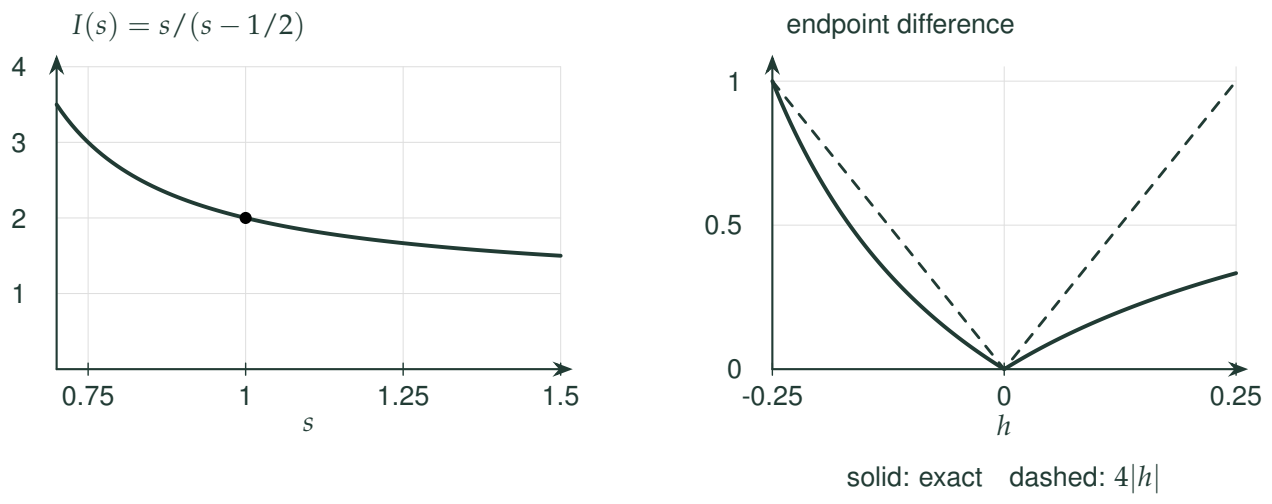
The left panel plots the explicit transform of the square-root envelope. The right compares the absolute endpoint difference with the dashed bound four times the absolute increment. The source calculates the endpoint and derivative from the formula; the graph supplies no arithmetic Euler-product identity.
Drawing labels and data 19 labels
Read the original labels as selectable text. Tables preserve grid relationships; other short labels are grouped compactly.
- 0.75
- 1
- 1.25
- 1.5
- 1
- 2
- 3
- 4
- \(s\)
- \(I(s)=s/(s-1/2)\)
- -0.25
- 0
- 0.25
- 0
- 0.5
- 1
- \(h\)
- endpoint difference
- solid: exact dashed: \(4|h|\)
Compute the endpoint rather than just naming it
For real \(s>1/2\),
At \(s=1+h\) this gives
The derivative at one is \(-2\). The logarithmic moment is finite as well: \(\int_1^\infty x^{-3/2}\log x\,{\mathrm d} x=4\). These are explicit calculations; the drawn curve does not establish differentiability or convergence.
The continuation performs the corresponding analytic steps for its actual summatory functions, with their explicit measurability and growth hypotheses. The arithmetic Euler-product identity, nonzero pole residues, and the required prescribed-prime divergence remain separate. Regularity of one Mellin transform does not construct all of those inputs.
Read this as
An analytic estimate controls a function already tied to arithmetic data. It is not a substitute for proving that tie.