
Paper X separates three questions that can look deceptively similar. Does a residual object exist? Does it extend coherently through every precision? Does the resulting object occur in the required carrier? A successful answer to one question does not supply the next.
Reading the drawing
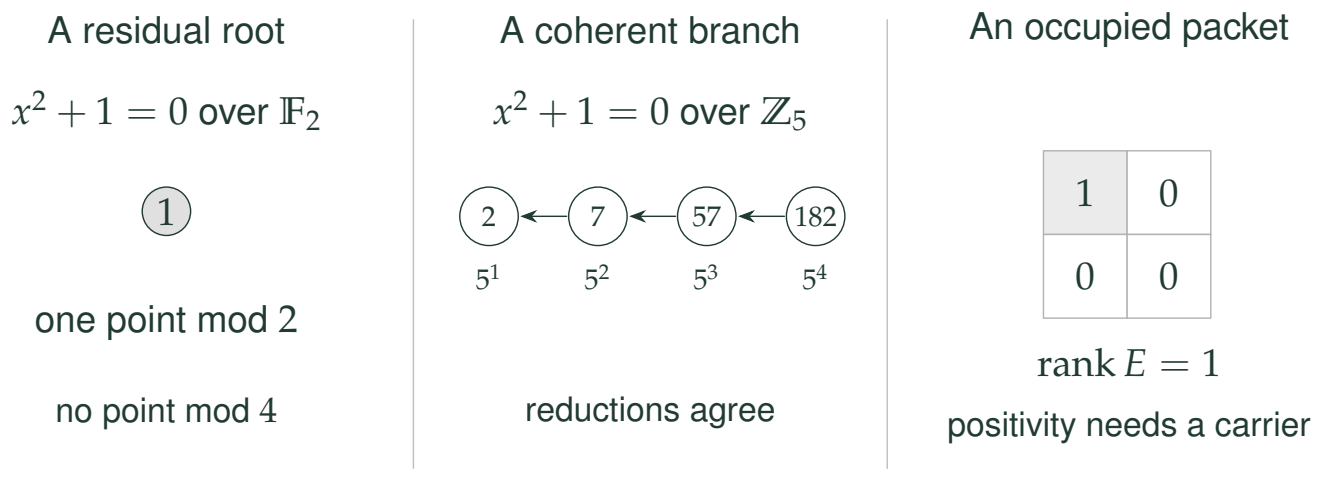
Three columns distinguish a root modulo two that has no lift modulo four, a compatible sequence of roots over powers of five, and a rank-one projector inside a supplied carrier. The arrows in the middle column follow reduction. None of the three columns supplies the hypotheses of the others.
Drawing labels and data 23 labels
Read the original labels as selectable text. Tables preserve grid relationships; other short labels are grouped compactly.
- A residual root
\(x^2+1=0\) over \(\mathbb F_2\)
- \(1\)
- one point mod \(2\)
- no point mod \(4\)
- A coherent branch
\(x^2+1=0\) over \(\mathbb Z_5\)
- \(2\)
- \(5^{1}\)
- \(7\)
- \(5^{2}\)
- \(57\)
- \(5^{3}\)
- \(182\)
- \(5^{4}\)
- reductions agree
- An occupied packet
| Row / column | Column 1 | Column 2 |
|---|---|---|
| Row 1 | \(1\) | \(0\) |
| Row 2 | \(0\) | \(0\) |
- \(\operatorname{rank}E=1\)
- positivity needs a carrier
Three models to keep in view
The scalar equation \(x^2+1=0\) has the root \(1\) modulo two, but no root modulo four. Over powers of five, the residues \(2,7,57,182\) form the beginning of a compatible branch. Neither fact constructs an automorphic carrier. In a supplied finite carrier, an idempotent such as \({\operatorname{diag}}(1,0)\) detects an occupied subspace; it does not explain where that carrier came from.
Read the appendix in three passes. Pages Visual 3–Visual 11 explain residual digits, finite counts, and obstruction spaces. Pages Visual 12–Visual 20 explain directed transport, common data, and finite occupancy. Pages Visual 21–Visual 29 give small exact models for the newer arithmetic continuation and its remaining limits.
Scope note from the source edition
Which ledger applies? The Block 27 and scalar/Mellin checkpoints record 17/20. The later checked assembly records 20/20 at the amended conditional scope. Its inputs are stated on the opening pages and in Appendix D. The finite character examples below are not proofs of prescribed Frobenius occurrence.
Evidence note from the source edition
The figures are exact-model illustrations, not pictures of an entire arithmetic moduli space. New Python checks support these examples. Saved Lean evidence is preserved separately. The October 20 production replay has its own source and compiler records in the Lean guide.