
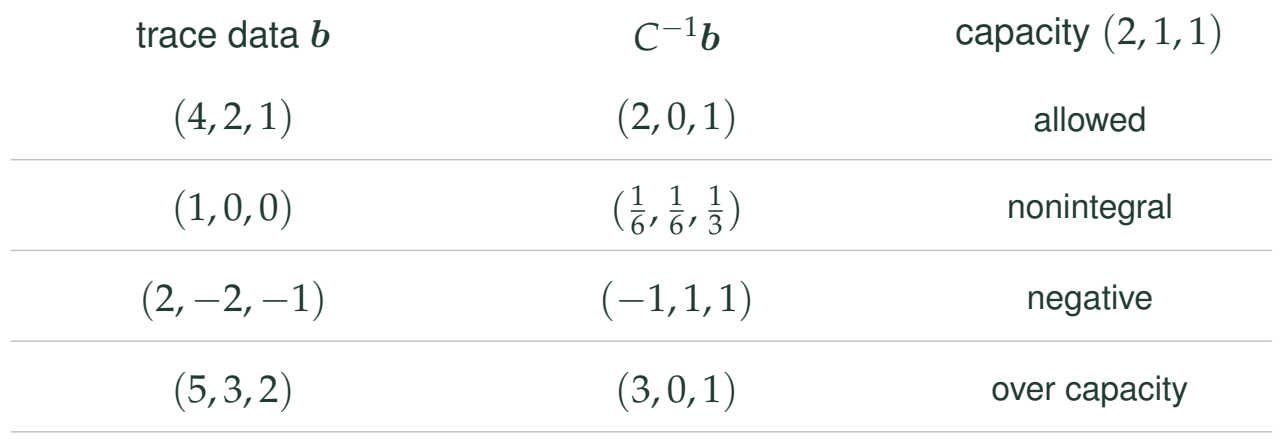
Keep the same separating matrix \(C\) and suppose the available carrier has capacities \(\boldsymbol c=(2,1,1)\). A recovered vector describes a genuine sub-sum of that carrier only if each entry is an integer and \(0\le m_i\le c_i\).
Reading the drawing
The displayed finite systems distinguish an algebraic solution from a nonnegative integral multiplicity vector within the supplied carrier capacity. The source retains all of these constraints before recovering a summand.
Drawing labels and data 15 labels
Read the original labels as selectable text. Tables preserve grid relationships; other short labels are grouped compactly.
- trace data \(\boldsymbol b\)
- \(C^{-1}\boldsymbol b\)
- capacity \((2,1,1)\)
- \((4,2,1)\)
- \((2,0,1)\)
- allowed
- \((1,0,0)\)
\((\frac{1}{6},\frac{1}{6},\frac{1}{3})\)
- nonintegral
- \((2,-2,-1)\)
- \((-1,1,1)\)
- negative
- \((5,3,2)\)
- \((3,0,1)\)
- over capacity
Three independent rejection tests
The trace vector \((1,0,0)\) gives \((1/6,1/6,1/3)\), so it fails integrality. The vector \((2,-2,-1)\) gives \((-1,1,1)\), which is integral but not nonnegative. The vector \((5,3,2)\) gives \((3,0,1)\), which exceeds the available capacities. In each case the linear equation itself has a unique rational solution.
The accepted example \(\boldsymbol b=(4,2,1)\) recovers \((2,0,1)\). When compatible constituent families are already supplied, the same admissible multiplicities define the corresponding direct sum at every coefficient place. This is the finite algebraic core of summand transport.
It does not supply a compatible family for an arbitrary object, construct all local attachments, or ensure that a proposed carrier contains the desired representation. The historical Claim 9.2 checkpoint left these comparisons partial. The later checked carrier theorem retains explicit constituent-copy presentations and supplied local comparisons rather than manufacturing them.
Read this as
Invert the trace matrix, then check the representation-theoretic constraints. A unique vector in a field need not be a realizable multiplicity vector.
Evidence note from the source edition
All accepted and rejected vectors are solved over exact rationals. The code rejects the wrong cases by their stated reason, not by a floating-point tolerance.